

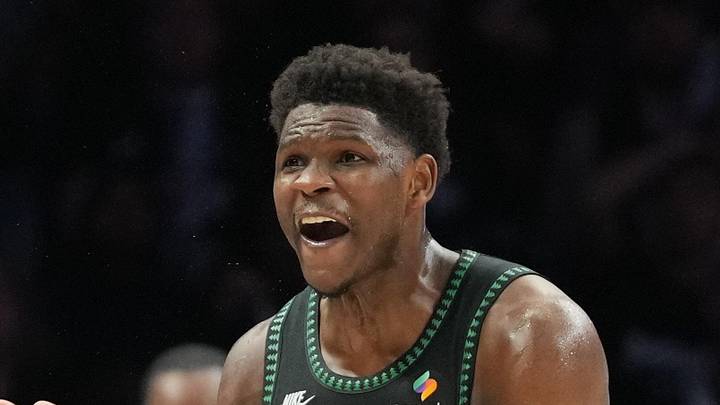
Both the Minnesota Timberwolves and Oklahoma City Thunder fell short against the San Antonio Spurs. It was under different circumstances, as the Wolves were blown out in Game 6 and the Thunder lost by eight points in Game 7, but the ultimate result was the same.
While neither Anthony Edwards nor Shai Gilgeous-Alexander performed flawlessly, they both played their part well enough, providing high-level scoring against immense defensive pressure. The major connection, though, was that their primary co-star underwhelmed.
Overall, Ant averaged 23.7 points on 46.9/37.5/80 shooting splits in the second-round while SGA averaged 25.9 points on 40.9/28.6/93.8 shooting splits in the conference finals. Yet, Julius Randle averaged just 12.8 points on 34.2/19/73.1 shooting splits, and Chet Holmgren averaged just 10.7 points on 51/27.3/76.9 shooting splits.
It's unfair to put all the blame on one player, but there's no denying that both Randle and Chet didn't do enough to support Ant and Shai.
Ant and SGA didn't get the production they needed from Randle and Chet
All series long, the Wolves needed more from Randle, and the Thunder needed more from Holmgren. And both players struggled mightily in the elimination game, Randle scored three points on 1-for-8 shooting, and Holgrem scored four points on 1-for-2 shooting.
Ant scored 24 points in Game 6 (no other starter scored more than 13) while SGA scored 35 points in Game 7.
Not getting solid production from their second options hurt both teams immensely, making it easier for the Spurs to pressure Edwards and Shai. Despite their greatness, having this much responsibility as the lone creator is tricky, especially for Ant, given his knee injuries.
The Spurs' elite perimeter defense of Stephon Castle, Devin Vassell, Julian Champagnie, Dylan Harper, and De'Aaron Fox, paired with the looming threat of Victor Wembanyama, made this strategy especially effective.
Now, there are some differences between Randle and Chet. For starters, Randle's series had less to do with poor aggression and more to do with poor decision-making. Notably, Holmgren averaged just 7.3 field goals per game -- far from ideal for the Thunder's hypothetical second scoring option. Throughout the series, he didn't insert himself into the offense.
Furthermore, while Randle was always supposed to be the Wolves' second scoring option, Holmgren was tasked with more responsibilities following injuries to Jalen Williams and Ajay Mitchell. After winning a championship last year, and given that he's 24 years old, Holmgren's future with the Thunder is secure. Conversely, Randle is poised to be traded as the Wolves search for a better co-star alongside Ant.
While the situations are slightly different, Edwards and Shai not getting the production they needed from the player who was supposed to be their running mate is a clear connection.
 Add us as a preferred source on Google