

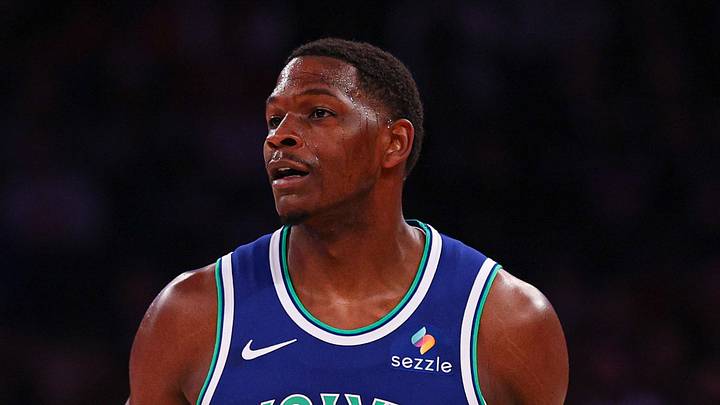
One of the ripple effects of Anthony Edwards' knee injury is that, since he's sidelined for roughly two months, he'll miss out on any regular-season awards by not playing 65-plus games. As a result, this will make him ineligible for a supermax extension this summer. The supermax is worth $304 million over four years, while the standard max is worth $337.6 million over five years. That's a $9 million annual difference.
Now, if Ant plays 65-plus games next season, he'll be eligible for a supermax in 2028, with one year left on his contract. Still, Edwards not being able to sign a supermax because he didn't make an All-NBA team in two straight years is quite silly.
And if Edwards doesn't play in 65 games again next season, then he'll miss out on supermax money. That's unfair given how talented he is.
The NBA needs to rethink how it determines contract eligibility
The Timberwolves would sign Edwards to a supermax contract without batting an eye. Nobody around the league would criticize this decision either. Edwards is a clear top-10 player. In my estimation, he's closer to the top five. If the Wolves determine he's worth the supermax, then they should be able to do so.
Awards shouldn't determine his worth, particularly since there's this 65-game threshold standing in the way. Last season, Edwards played in 61 games. During these games, Ant was, at bare minimum, a top-10 player. Before the 65-game rule, which was introduced in the 2023-24 season, he would have easily been an All-NBA player and thus earned a supermax this past summer. Alas, he missed the mark by four games.
There are so many problems with the 65-game rule and how awards are tied to contracts. In theory, I get it—players need to be on the court more, and it's good to have a safeguard so teams don't pay injury-prone players supermax money. Regardless, Ant isn't injury-prone. In fact, until last season, he had never played in fewer than 72 games.
More generally, 65 games is an arbitrary cut-off, and it should be up to the voters to weigh specific factors. And while Edwards played in 61 games, he played over 200 more minutes than Jalen Duren, who made the All-NBA Third Team. Given the financial implications at play, we've also seen players force themselves to play through injuries to hit the threshold. That's not what anyone should want to see, as it could lead to more injuries.
Maybe the biggest question is, though: Should 100 media members determine which players should be eligible for what contracts? And the answer is clearly no.
The point is that the system is beyond flawed in many ways, and Edwards' injury is putting a spotlight on these issues.
Anthony Edwards not being supermax eligible has implications for the Timberwolves
For the Timberwolves, this rule has real implications. Maybe there's a chance this works out in a roundabout way. Edwards could take the standard max, worth five percent less of the cap, which could help them navigate the second apron challenges and other cap complications.
Perhaps Edwards takes a one-year extension for some extra security while keeping the door open for a supermax. We saw Jaden McDaniels sign a similar contract this offseason.
Realistically, though, Edwards being ineligible for a supermax will delay extension talks. While I don't believe this will lead to Edwards eventually changing teams, this rule makes his future unnecessarily less certain.
If it's not clear by now, the NBA needs to change how they determine who is eligible for supermax contracts because the current system is broken.
 Add us as a preferred source on Google