

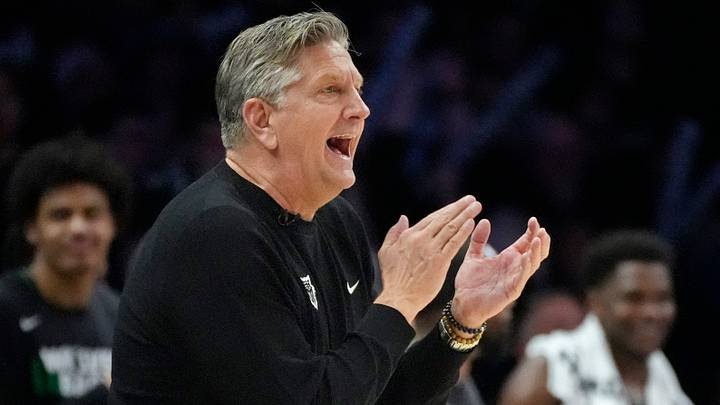
It's easy to forget this, but when the Minnesota Timberwolves hired Chris Finch in 2021, he was viewed as an offensive guru. In Finch's five full seasons as the Timberwolves' head coach, Minnesota has only ranked in the top 10 for offensive rating twice, per Cleaning the Glass.
Criticize Finch if you'd like (it's true he has been the most creative offensive mind), but the reality is that he has consistently given clunky rosters that weren't truly set up to be elite offenses. Thankfully, Finch has helped instill a defensive identity, and this has resulted in two conference finals runs. Moreover, Finch has shown that he is one of the best game-plan coaches in the league.
With a more offensively slanted team, though, Finch's offensive acumen will be highlighted more. Likewise, he'll play a crucial role in maximizing the Wolves' sky-high offensive ceiling.
Chris Finch needs to maximize the Timberwolves' offensive upside
Now, if the Timberwolves finish with a top-three offense, I can already hear Finch detractors saying he simply benefited from a talented roster. While the Timberwolves' roster has a ton of talent, putting it together won't be simple.
How do you maximize LaMelo Ball's playmaking? How do you balance the usage puzzle, particularly with Jonathan Kuminga in the fold? How do you balance calling plays with letting players be themselves? That's where Finch's role comes in.
I think there's a lot of value in the free-flowing offense that Finch typically leans on. Ball and Kuminga will certainly benefit from this style of play. Still, we saw LaMelo thrive playing in a structured offense with the Charlotte Hornets last season. Finch should implement some of these staple plays, whether it be simple pick-and-roll actions, some guard-to-guard screening, or zoom actions.
Earlier this offseason, Finch openly discussed taking on a more hands-on role. This shift could help maximize LaMelo's fit, the Wolves' overall roster, and highlight Finch's offensive mind.
With how many offensive threats the Timberwolves have, including Ball, Anthony Edwards, Jaden McDaniels, Ayo Dosunmu, and now Kuminga, Finch's play-calling will help solve the usage puzzle, ensuring ample involvement from everyone.
Finch has never coached two creators this talented, which naturally opens up more creative schemes. Another thing that Finch will be tasked with is drawing up more off-ball actions for Edwards.
Again, though, balance will be key. No coach calls every single play; sometimes you need to let your stars cook, and Finch has long leaned on a more free-flowing approach to offense. How hands-on Finch is and how creative his schemes are will be under-the-radar factors in the Wolves' offensive success.
There's also a ton of weight on Finch's shoulders to manage the unique personalities on this roster. Amid all the talk about how the new roster will mesh, Finch's role can't be ignored. Undoubtedly, a successful Timberwolves season will go hand in hand with Finch showcasing his offensive creativity.
If everything goes right, he could help Minnesota be the league's best offense and set them up as a challenger to the San Antonio Spurs and Oklahoma City Thunder.
However, there's a scenario where Finch can't maximize the roster talent around him, and the Timberwolves opt to part ways with him.
 Add us as a preferred source on Google