

The Minnesota Timberwolves need a point guard. That has been said countless times about the team over the past few years. While there's a solid chance that this need will be addressed via the trade market, having some extra ball handling and guard depth isn't a bad thing, especially after what we saw from the Wolves this past season.
As such, if the Wolves keep their first-round pick, it wouldn't shock anyone if they target a lead guard.
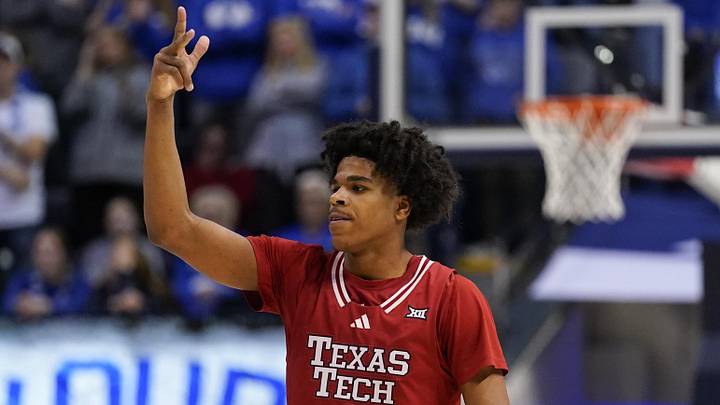
When looking at guards who could be realistically available at pick No. 28, Texas Tech's Christian Anderson stands out as someone who should be on Minnesota's radar. Anderson's 3-point shooting and playmaking are two bankable NBA skills, and it just so happens to be two of the main skills the Wolves need.
Anderson's blend of shooting and playmaking is exactly what the Wolves need
After a solid freshman season, Anderson enjoyed a breakout sophomore campaign, which established him as a first-round talent. He averaged 18.5 points, 3.6 rebounds, and a Big 12-best 7.4 assists with 47.5/41.5/80.5 shooting splits.
In addition to his aforementioned 7.4 dimes per game, Anderson posted an absurd 35.2 assist percentage, which ranks in the 89th percentile per Draftballr.
Anderson's playmaking vision and ability to organize an offense allow him to thrive in a floor-general role. He especially excels at operating in the pick-and-roll, creating open looks for himself and his teammates.
At the same time, Anderson's elite 3-point shooting can allow him to thrive off the ball. An absurd 60 percent of Anderson's shots were from beyond the arc -- he is comfortable both spotting up and draining difficult self-created shots.
There are some concerns about Anderson's frame translating to the NBA level. Notably, he measured in at 6-foot.75 and 180 pounds at the combine. Nevertheless, Anderson's shooting and feel for the game should negate some of his size limitations.
As noted, the Wolves need both a table setter and some extra shooting -- this, in turn, would make Anderson a seamless fit. In recent years, it's been difficult for rookies to carve out a role with the Wolves.
However, Anderson's ability to play a spot-up role alongside Anthony Edwards and take some ball-handling duties away from him could help him earn some minutes as a rookie.
With Donte DiVincenzo sidelined for at the very least most of the season, the Wolves could stand to benefit from some extra spot-up shooting. As we saw in the playoffs, the Wolves also need players who are comfortable handling the ball and making plays for others.
The Wolves have long counted on Mike Conley for two main skills: shooting and playmaking. Conley will be 39 next season, though, and has already declined significantly. As such, the Wolves need to find other players who can provide these two key skills.
Conley isn't a perfect one-for-one comparison for Anderson. Likewise, a rookie replicating Conley's terrific basketball IQ and stabilizing playmaking isn't realistic, especially given that Anderson somewhat struggled with turnovers in college.
Regardless, in terms of a quality table setter who can also excel in a spot-up role, Anderson shares clear similarities to Conley.
The rest of Anderson's game
Anderson doesn't offer the same elite shot creation as some of the top-end guards in this class. That's in part why he could fall to the Wolves' range. Just 19 percent of Anderson's shots came at the rim, which is the lowest mark among the lead guards who are projected first-round picks.
Still, he is a crafty below-the-rim finisher who uses his tight ball-handling abilities to his advantage when attacking the basket. Notably, Anderson shot 74.2 percent at the rim, which ranked in the 96th percentile per Draftballr. While he won't generate a ton of rim pressure, it's nice to know that when Anderson does get the rim, he converts at a high rate.
Without a doubt, though, the main appeal of Anderson is his playmaking and shooting chops, which again are two skills the Wolves could sorely need.
I would also argue that while Anderson's lack of rim pressure could limit his star upside, the Wolves could simply benefit from drafting a complementary guard who can provide the vital skills of playmaking and shooting.
Anderson's size is a major concern on defense, but the Wolves have the defensive personnel to negate this weakness. In my eyes, his shooting and playmaking profile also outweighs some of these worries.
Why Anderson is a realistic draft target for the Wolves
It's worth mentioning that when Anderson announced he would stay in the draft, it was reported that he was projected to be a top-20 pick.
Nevertheless, surprises always happen in the draft. Last year, for instance, Kasparas Jakucionis was viewed as a clear lottery pick but fell to the Miami Heat at 20, and Danny Wolf falling to pick 27 was yet another shocker.
Anderson isn't in the top tier of guards with the likes of Darius Acuff and Keaton Wagler. Instead, Anderson is in the same tier as Ebuka Okorie, Bennett Stirtz, and Labaron Philon. With this year's guard class being deeper than most drafts, it's possible one of these four guards will fall as teams prioritize other positions.
Given their perceived lack of upside, Anderson and Stirtz are the most likely candidates to fall among these four guards.
Kevin O'Connor of Yahoo recently had Anderson being drafted at pick 39. He is far lower on Anderson than consensus, but this shows that he can fall right into the Wolves' lap. And if that happens, it would be difficult for Minnesota to pass up on adding Anderson, given their current roster construction.
 Add us as a preferred source on Google