

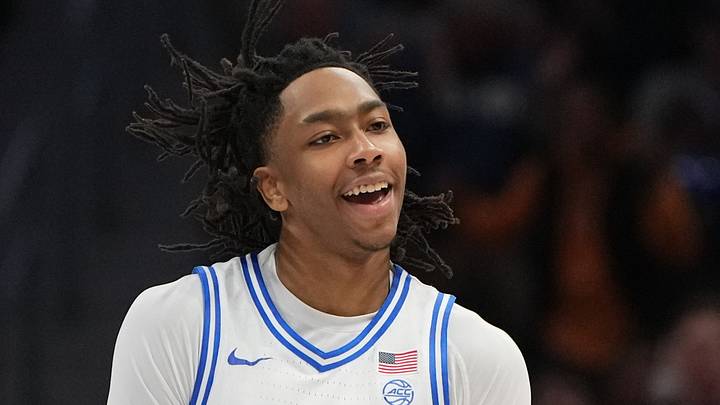
Minnesota Timberwolves rookie Isaiah Evans clearly has some upside. Evans was expected to be a first-round pick, so the Wolves landing him at pick 33 was excellent value. His 3-point shooting gives him a bankable NBA skill.
Regardless, the slim 186-pound shooting guard might take some time to stick at the NBA level. And for what it's worth, his play in summer league didn't do much to prove that he's ready, as he netted just 20.5 percent of his 3-pointers. Look, summer league often doesn't mean much, and his shooting should bounce back, but there weren't many positives with Evans' SL experience. The Wolves' suddenly loaded guard rotation doesn't do Evans any favors.
One of the most common pre-draft comparisons for Evans was Isaiah Joe. The similarities go beyond their first name: both players are wiry-framed off-guards who can shoot the leather off the ball and thrive as movement shooters, yet both players have limited playmaking abilities. Plus, while Evans was drafted 16 spots higher, both players were second-round picks.
Joe's path to carving out a rotational role should set the expectation of patience for Evans. An expectation Timberwolves fans should keep in mind if and when Evans doesn't see the floor much as a rookie.
Isaiah Joe's journey to NBA success could be a blueprint for Isaiah Evans
In his first two seasons with the Philadelphia 76ers, Joe averaged just 10.3 minutes and 3.7 points. Philly waived Joe, clearing the way for him to sign with the Oklahoma City Thunder. Joe quickly earned a rotational role and didn't turn back. In four seasons with OKC, he averaged 20.1 minutes, 9.7 points, and shot 41.5 percent from 3-point range.
Now, of course, Wolves fans hope this exact path isn't repeated, and it's also fair to be critical of Philadelphia's handling of him. My point, though, is that there's a path for a slim guard who isn't a plus playmaker to earn a role as a key bench player on a winning team. However, this might take a few years.
While it was originally fair to expect Evans to have a role as a rookie, the Wolves' improved guard/wing depth makes things harder for him, and his summer league didn't inspire confidence. Furthermore, given his thin frame, adjusting to the physicality of the NBA was always going to be a question. Sometimes these players simply need a few years to develop.
Thankfully, the Timberwolves can afford to be patient with Evans (to some extent). With Bones Hyland, Terrence Shannon Jr., Jaylen Clark, Josh Green, and Donte DiVincenzo (when he returns), the Timberwolves have ample guard/wing depth.
Evans can get some limited situational minutes as a rookie (and likely more of the same as a second-year player), but by year three he could be ready to earn a role as a spot-up shooter and sparkplug scorer. In the meantime, Evans can work on adding some strength, learn from established pros, and get some reps between the NBA and G League.
Long-term, having a movement shooter with some general microwave scoring abilities and, hopefully, some solid defense should benefit the Timberwolves' bench.
While it's not a perfect comparison, Isaiah Joe's path to NBA success could provide a blueprint for Evans.
 Add us as a preferred source on Google