

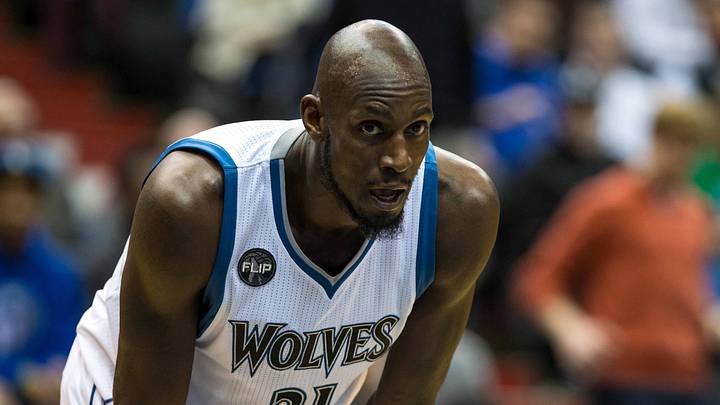
The Minnesota Timberwolves had their first taste of success in the early 2000s, and it coincided with the arrival of Kevin Garnett. The Big Ticket became the biggest star in franchise history as the Wolves rose to prominence, but the biggest challenge was putting players around him to help Minnesota chase a championship.
This is a challenge that Tim Connelly is experiencing with Anthony Edwards in the present, but former GM Kevin McHale was his own worst enemy, surrendering a total of five first-round picks after the Wolves were involved in a salary cap circumvention scheme with forward Joe Smith.
The scheme is one of the most infamous events in Timberwolves history. But it also cost them a chance to pair Garnett with a future Hall of Famer, Tony Parker, and extend their championship window.
Timberwolves’ Joe Smith scheme blew their chance at drafting Tony Parker
The chain of events started when Smith and the Timberwolves agreed to a series of under-the-table contracts in 1999. Smith, who averaged 13.7 points per game and 8.2 rebounds in his first season in Minnesota (1998-99), agreed to sign three consecutive one-year contracts below market value in order to stay with the team and help them build a complete roster.
While the deals were worth somewhere between $1.75 million and $2.5 million, the final result would be a seven-year, $86 million extension when the team acquired his “Bird Rights,” which allows a team to exceed the salary cap to re-sign their own players.
The Wolves may not have been the only team doing this at the time, but the problem is they got caught. According to a 2014 article by Eric Goldman of Cainus Hoopus, Smith’s agent Andy Miller left his sports agency to start his own and brought Smith and Garnett with him as his first clients. Eric Fleisher, who owned the agency, retaliated by suing Miller, and during the legal proceedings, written documentation of the agreement was found and given to the NBA.
This set off former NBA commissioner David Stern and convinced him to make an example out of the Wolves, voiding all of Smith’s contracts and issuing a $3.5 million fine. Owner Glen Taylor was served a one-year suspension, and McHale was forced to take a one-year leave of absence, but Minnesota was also stripped of five consecutive first-round draft picks from 2001 to 2005.
While the NBA later restored their 2003 and 2005 picks, it prevented the Wolves from surrounding Garnett with talent on a similar timeline and ultimately cost them the chance to take Parker in the 2001 draft.
With their 47-35 record during the 2000-01 season, they would have been picked 18th, which is 10 spots before Parker was selected with the 28th overall pick by the San Antonio Spurs. However, Parker was nearly drafted pick 21 by the Boston Celtics, so the Wolves drafting him at 18 could have happened.
Tony Parker would have kept the Timberwolves’ window open through the 2000s
Parker paired with Tim Duncan and Manu Ginobili and went on to win four NBA championships with the Spurs. Although there’s no guarantee that the same thing would have happened in Minnesota, he likely would have been the point guard the Wolves were looking for to team with Garnett.
It also would have been a stylistic fit for head coach Flip Saunders. By utilizing the pick-and-roll, Garnett could use his mid-range game, roll to the rim, or kick to the outside from Parker’s creation on the perimeter. Garnett’s defense would have also helped Parker, and it would have been the foundation for a team that would at least have a shot at the title and likely have prevented Garnett’s 2007 trade to the Boston Celtics.
The Wolves tried to counter by trading for Sam Cassell and Latrell Sprewell before the 2003-04 season. While those moves helped Garnett win the MVP award and lead them to the Western Conference Finals, it was a one-year window where the roster aged out overnight and sent the Wolves back into the darkness that lasted throughout the late-2000s and most of the 2010s.
For a franchise that’s had its fair share of shooting itself in the foot, losing out on Parker for Smith, who returned to Minnesota for two seasons before being traded to the Milwaukee Bucks as part of the Cassell deal, is another All-Time blunder. And with the Los Angeles Clippers in the news for a different salary cap circumvention scheme with Kawhi Leonard, Wolves fans may be interested if current Adam Silver comes down as hard on a big market team as Stern did on the Timberwolves.
The Clippers situation will play itself out. But it also could remind Wolves fans of missing out on a Hall of Famer that could have changed the trajectory of the franchise.
 Add us as a preferred source on Google