

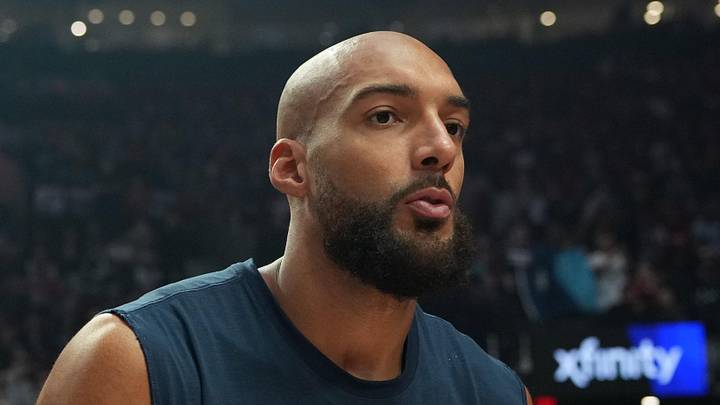
The Minnesota Timberwolves seem primed for some level of change this offseason, particularly regarding the frontcourt pairing of Julius Randle and Rudy Gobert. Given his stellar defense against Nikola Jokic in the first-round and his ability to raise the floor of any defense he's on, Gobert could very well have more value than Randle.
However, Gobert's floor-raising abilities could appeal more to younger teams or more generally future-based packages. When previewing the Timberwolves offseason on the Game Theory Podcast, Sam Vecenie and Bryce Simon came up with the Charlotte Hornets and Atlanta Hawks as possible suitors for Gobert.
Their proposed Hornets' package centered around the 14th and 18th picks (with the possibility of another pick), along with Moussa Diabaté, Tidjane Salaün, Grant Williams, and Josh Green. On the Hawks' side of things, Vecenie and Simon came up with a package centered around Jonathan Kuminga, Zaccharie Risacher, Mouhamed Gueye, and the No. 8 pick.
By all accounts, both of these are amazing returns (especially the proposed Hawks offer) for a soon-to-be 34-year-old center, and it would also open up some financial flexibility for next offseason. In terms of getting a haul for Gobert, you'd be hard-pressed to find a better return than the proposed Hawks deal. Still, accepting an offer like this might end up forcing the Wolves to embrace a gap year for the 2026-27 season.
In the long run, this could benefit Anthony Edwards and company, but it would almost certainly result in them taking a step back in the immediate future. Would the long-term benefits of building a sustainable contender outweigh the unfortunate reality that next season would be a step back?
Trading Rudy Gobert for a future-based package could set up a gap year
Now, I do think the Wolves would explore packaging Randle and some of the assets they acquired for a star. Unless it's for someone like Giannis Antetokounmpo, though, the Wolves will be left with at least some level of promising yet raw young talent, if a deal like the ones outlined becomes reality.
There's also a scenario where they can't find an ideal second trade for Randle, even with the extra assets. If this happens, the Wolves could trade Randle alone for whatever he's worth and fully pivot to a younger timeline.
Without a doubt, accepting an offer like one of the deals proposed by Vecenie and Simon could put the Wolves at a crossroads both in terms of their next move and outlook for next season.
Especially if the Wolves get the No. 8 pick from Atlanta, they could find an ideal long-term backcourt partner and possible co-star for Edwards. We just saw that gamble fail with Rob Dillingham, though. If the Wolves bring in another high upside young guard, such as Kingston Flemings or Mikel Brown Jr., Chris Finch's approach would have to change.
Kuminga would offer some level of scoring, but can he do "the little things" well enough to contribute to winning basketball? Risacher would be an interesting flier on a former No. 1 pick, but not someone the Wolves could depend on for heavy minutes.
Regarding the proposed Hornets' package, the possibility of adding two rookies is complicated for a team with title aspirations. Even if the Wolves draft two polished rookies, it would have to be viewed as a long-term investment rather than a win-now push.
Diabaté is a great energy big man who long-term could create an interesting center rotation with Joan Beringer. Is he ready to be the starting center on a title team, though? The answer is probably not.
You get the point, these deals offer promise, but they wouldn't help the Wolves win next season.
The Timberwolves could ultimately benefit from a gap year
Of course, the Wolves' ultimate goal is to win a championship, and an infusion of young talent may be what they need to build a viable long-term contender, especially to match up with the Oklahoma City Thunder and San Antonio Spurs. A possible deal from the Hawks or Hornets could help the Wolves accomplish this while setting them back in the immediate future.
If the Wolves fully embrace a youth movement, it could pay dividends long-term, and maybe it will result in them being top-tier contenders as soon as 2028 or 2029.
Undoubtedly, though it requires buy-in from all parties, and they'd have to understand that 2027 wouldn't be their year. For a team that's been to two out of the last three conference finals, that's easier said than done.
At this juncture, there's a lot of speculation involved when looking at these possible trade offers. Regardless, given his floor-raising abilities, it's fair to assume a possible Gobert trade will more likely result in a future-based package rather than a win-now one, which would put Minnesota in a pickle.
 Add us as a preferred source on Google