

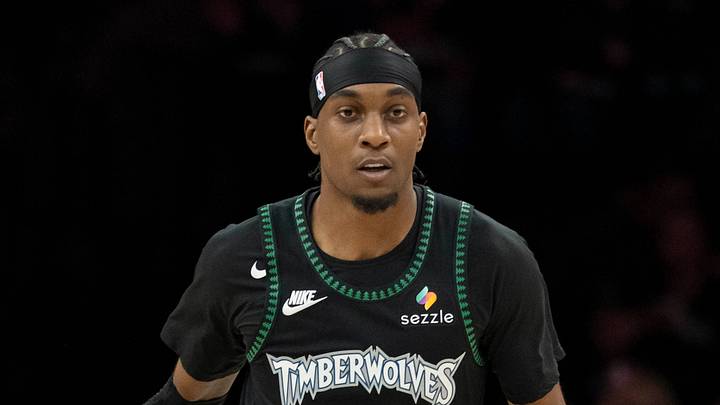
Without a natural power forward, Jaden McDaniels' role on the Minnesota Timberwolves is suddenly unclear. He has long thrived as a perimeter stopper, and he's still the Wolves' best option on the perimeter. At the same time, his length, strength, and general defensive prowess make him the best option to defend opposing forwards.
As such, figuring out where to deploy him is a tough call with how the roster is currently set up, even if it seems like Chris Finch prefers him at the point of attack. Giving Jaylen Clark a bigger role could help the Timberwolves navigate this dilemma.
Clark hasn't played a sizable role in the Timberwolves' rotation during his two healthy seasons with the team. Still, in limited opportunities, he's thrived as a point-of-attack defender. If Clark gets more minutes, this could free up McDaniels to guard forwards. Alternatively, at 6-foot-5, 205 pounds (20 pounds heavier than McDaniels), Clark could be a sneaky solution to the Timberwolves' power forward woes.
Frankly, Clark is a better POA and forward option than Anthony Edwards or Ayo Dosunmu, which gives him a chance to solve the Timberwolves' aforementioned dilemma.
Jaylen Clark can defend both guards or forwards
Conventional wisdom would suggest the Timberwolves should keep Clark at the point of attack. That's been his primary role, and he's thrived in his limited minutes. Per Basketball Index, Clark ranks in the 85th percentile for perimeter isolation defense and the 91st percentile for matchup difficulty. He's extremely stout on the ball and mirrors players' movement at a truly elite level. Furthermore, he changes the energy of the game with his tenacious playstyle and affinity for hustle plays.
This paired with McDaniels being 6-foot-9, makes the decision seem easy: play Clark at the POA to free up McDaniels to guard forwards.
However, in a perimeter-centric league, defending forwards is inherently easier than against guards. In other words: ensuring you have elite POA attack defense should be a priority over defense against forwards. Clark has flashed high-end perimeter defense, but McDaniels has proven to be a top-tier on-ball stopper. To this end, keeping him where he's thrived makes sense.
And while Clark has mainly defended opposing guards, he is strong enough to guard up. Clark is also a disruptive defensive playmaker, which could help him play a roamer role if the matchup calls for it. Yes, he might struggle against the most physical forwards like Zion Williamson, but utilizing Clark as a defender against forwards could be the best option to keep McDaniels where he's had proven success.
In reality, we'll probably see Clark play both at the point of attack and against forwards.
There's plenty of logic to playing him alongside McDaniels. As outlined, this could help the Timberwolves figure out some of their power forward woes and solve their McDaniels conundrum. Nevertheless, Clark could also stabilize their POA defense when McDaniels is off the court.
Overall, Clark can help the Timberwolves deploy McDaniels in their preferred way, in turn addressing a key concern, and he certainly gives Minnesota some enticing options.
Clark needs to add a consistent 3-point shot
Clark's defensive chops and low-usage offensive game could help him become a sneaky starter. The unfortunate truth is that Clark's offense is miles behind his defense. There's value in players who don't create for themselves and can simply play off the ball, especially for a Wolves team with so much established talent.
It comes down to knocking down open shots, though. Shooting 32.7 percent from 3-point range last season, that's not something we know Clark is capable of.
Clark has a long way to go to become a respected shooter. The question is, though: Can he make open 3-pointers when the defense collapses on LaMelo Ball or Anthony Edwards? The answer to this question will determine whether Clark becomes a crucial part of the Wolves' rotation or someone who you can't play in big spots because of his offensive limitations.
That's obviously a big difference, but that's how much a jump shot matters. Regardless, if Clark can add a consistent outside shot, he could help solve a key issue for the Timberwolves.
 Add us as a preferred source on Google