

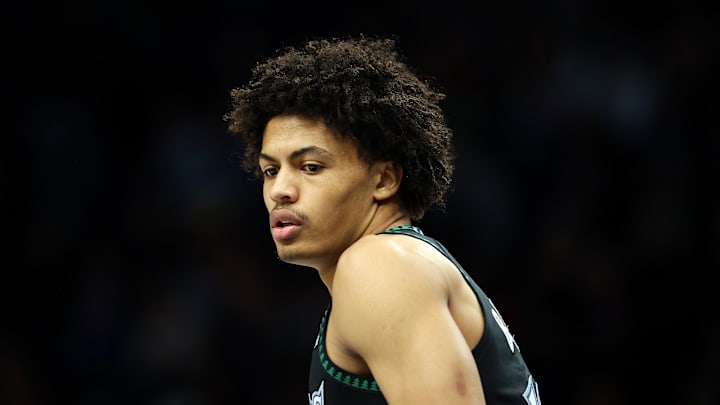
Minnesota Timberwolves fans were hoping to see Joan Beringer earn a consistent role after a stellar 13-point, five-rebound rotational debut against the Milwaukee Bucks last week. However, they were disappointed when Beringer played just seven minutes when the Wolves' frontcourt returned to full strength. Beringer stepped up again, though, pouring in 10 points and eight rebounds against the San Antonio Spurs with Rudy Gobert sidelined and Naz Reid leaving the game with an injury.
In the two games since, though, Beringer has played eight total minutes. This level of production against two stellar opposing frontcourts shouldn't be ignored -- but unfortunately, it is.
He is quickly learning how difficult it is to earn a rotational role, even if you play well. Beringer's situation is different from Rob Dillingham's in several ways. For starters, Beringer's highs have been higher than Dillingham's. However, one clear similarity is Chris Finch's willingness to play them limited minutes and pull them for minor mistakes.
On Thursday night, poor defense from Beringer led to a wide-open Josh Giddey layup, and the rookie not playing for the rest of the game. Or hey, maybe Finch just likes seeing his young players in three-minute spurts!
Ultimately, the Wolves lost their fourth straight game, and Beringer's minutes had little impact on the game. Yet this dynamic is something that fascinates me.
Inconsistent minutes don't help anyone
Being able to play minutes yet not being trusted to ride out the natural growing pains young players are bound to deal with clearly impacted Dillingham. The second-year guard has struggled immensely in his limited minutes this season, averaging just 3.6 points on a 38 percent effective field goal percentage. He has been out of the Wolves' rotation since mid-December and appears to be a trade candidate.
Even when Dillingham played, he had an incredibly short leash, and it's clear that his confidence took a hit. Maybe he's not good -- it's tough to succeed as a slender 6-foot-2 guard. Regardless, I can understand how difficult it would be to feel like you can't make a single mistake and how this may impact your confidence.
Listen, being an NBA coach is hard, and balancing a team's desire to win with developing young players is one of the hardest things a coach can do. That's why they're paid the big bucks, though.
Now, I doubt that Beringer's confidence will disappear as Dillingham's did. It's simply different for a microwave scoring guard compared to a rim-running big man. Still, I can imagine it's frustrating for Beringer to not be given a chance to play significant minutes after proving he can contribute.
Frankly, playing under 10 minutes a game is no way for any player to develop. If the Wolves are going to play Beringer -- they must commit to it a bit. I'm not saying he should play 20-plus minutes a night, but a respectable 12 to 15 seems fair.
I get that it's tricky with the Wolves' loaded frontcourt, but they need extra rim protection, and Beringer can provide that. Overall, Finch's current handling of Beringer isn't helping anyone, and there are some similarities to Dillingham's early-season minutes.
 Add us as a preferred source on Google