

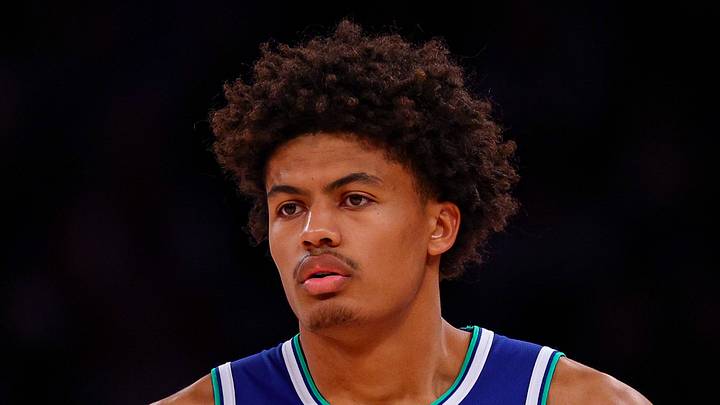
Rudy Gobert's offensive struggles have undeniably been a problem for the Minnesota Timberwolves this season. He's averaging just 7.7 points on 46.6 percent shooting from the field. Gobert isn't finishing with physicality, and he's coupled this with some baffling turnovers. In the Wolves' most recent game against the New York Knicks, Gobert shot 4-for-6 from the field, but he had an egregious out-of-bounds pass and was stripped under the rim in clutch time.
Much to the dismay of many Wolves fans, though, Gobert's minutes still sit at 29.2 per game, while Joan Beringer's minutes are at 16.8 per game. For as frustrating as Gobert's offense can be at times, I actually understand this minutes distribution. Gobert is a liability on offense, but he remains a top-three or so defender in the league.
Conversely, while Beringer is already a more effective offensive player than Gobert, his defense is miles worse. As such, for Beringer's minutes to increase and Gobert's to decrease, the second-year big man will have to show defensive improvement.
To be clear, Beringer won't magically become an elite defender overnight. However, with steady improvement, the MPG gap between the two players will close, and Chris Finch will be able to trust Beringer in high-leverage moments.
Joan Beringer's defense must improve for him to earn more minutes
The on/off splits are telling. According to Cleaning the Glass, Minnesota's defense is 15.6 points per 100 possessions worse with Beringer on the floor, and 16.8 points per 100 possessions better when Gobert plays. Overall, the Wolves are 5.5 points per 100 possessions better with Gobert on the court, and 8.4 points per 100 possessions worse when Beringer plays.
Statistically, Gobert's defense outweighs his offense, while the opposite isn't true for Beringer. Now, coaches don't build their rotations from on/off splits. Regardless, the numbers explain Finch's logic and trust in Gobert, in addition to his overall experience.
Beringer has a ton of defensive upside, and he's flashed his upside on that end, with a four-block game against the Portland Trail Blazers being the best example. Unfortunately, Beringer has struggled with consistency and positioning. Against the Knicks, there was one play that's seared into my mind. Beringer was guarding Andre Drummond until he switched onto the perimeter during a pick-and-roll; the problem was, Beringer didn't recognize when LaMelo Ball recovered, which led to an easy shot for Drummond.
This is a subtle play, but it highlights that Beringer's defensive IQ and positioning need to improve. There are plenty of plays like this during his minutes. While these mistakes aren't as loud as Gobert's offensive lapses, they are just as costly.
Beringer also struggles to deter shots at the rim. Notably, per Cleaning the Glass, opposing teams shoot 7.5 percent more shots at the rim when Beringer is on the floor (which ranks in the 1st percentile), and they shoot them with 9.3 percent more accuracy (5th percentile). In contrast, Gobert is one of the league's best rim protectors.
These skills must sharpen up for Beringer to earn a bigger role.
The Timberwolves have the league's best defense, and Gobert is the main reason why. Therefore, Finch lives with his offensive problems. Look, I would've closed the Blazers game with Beringer when Gobert didn't make a field goal. Generally, though, Gobert getting sizably more minutes than Beringer, and him closing games, makes sense.
Beringer can catch lobs consistently and finish with power. Those skills are valuable, and they make him an upgrade over Gobert. Yet, he's not a strong screener or short roll passer. In other words, his offense isn't perfect either, which, paired with his defensive flaws, hinders his minutes and impact.
So while Gobert's offensive struggles are problematic, I fully understand why the minutes are what they are.
To be clear, Beringer's problems shouldn't be a surprise. He just turned 20 years old and only started playing basketball in 2021. Frankly, he's ahead of schedule as a solid backup big man.
Given his age and solid play, the possibility of Beringer developing on defense shouldn't be overlooked. Until this happens or the Timberwolves trade Gobert, though, expect the minutes split to stay mostly as is, and for Rudy to close games.
 Add us as a preferred source on Google