

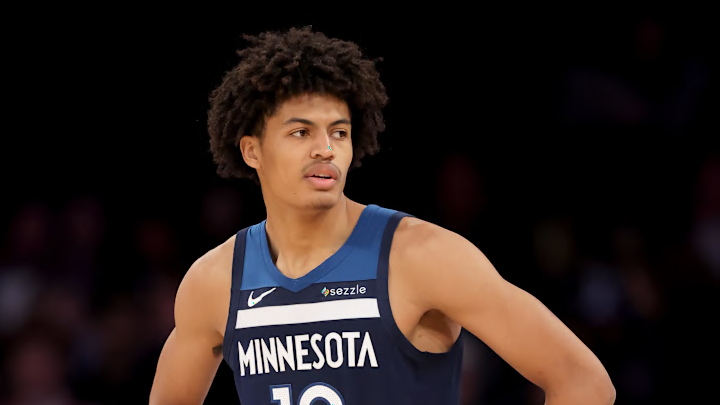
Throughout his rookie season, Joan Beringer hasn't played much. However, when called upon, the Minnesota Timberwolves big man has impressed. Notably, in the three games in which Beringer has played double-digit minutes, he has averaged 10.6 points (on 82.3 shooting), 5.6 rebounds, and a block.
Fans have understandably been begging to see more of Beringer after these three outstanding games in January. The problem is that the Wolves' frontcourt is too loaded for Beringer to consistently earn minutes. Cutting the minutes of either Rudy Gobert, Julius Randle, or Naz Reid isn't ideal -- especially with Ayo Dosunmu now demanding 25-plus minutes.
As such, the only path to Beringer earning minutes is for the Wolves to lean into an unconventional triple big lineup. Given Finch's resistance to this throughout the year, this feels unlikely. Nevertheless, the reward may outweigh the risk.
The advantages of playing Beringer are clear
Amid other concerns about the Wolves, it's easy to forget just how much the team has struggled with Gobert off the court. Per Cleaning the Glass, with Rudy on the court, Minnesota has a 108.7 defensive rating; without Gobert, the Wolves have a 121.2 DRTG. This is the difference between the second and 29th best defense.
Now, Dosunmu's arrival certainly helps the Wolves' defense when Gobert is off the court. However, in an ideal world, the Wolves have high-level rim protection with Gobert off the court, and the easiest way to get there would be unleashing Beringer.
Of course, playing a triple big lineup with Naz at three three is risky on defense. Reid doesn't have the speed to keep up with opposing small forwards, and quicker teams could especially expose this problem. Notably, in the 21 possessions, this three-man lineup has an 161 DRTG.
Still, the sample size is limited, and as time goes on, it's possible that Reid becomes more comfortable with this new defensive role. It's worth noting that triple big lineups with Gobert instead of Beringer have fared much better on defense, posting an amazing 102.7 DRTG. Thus, it's likely that with more reps, supersized lineups with Beringer will improve defensively.
Frankly, if the Wolves want to keep this four-man frontcourt together long-term, the only path is to regularly play triple big minutes.
While the triple big lineups with Beringer have yielded poor defensive results, offensively, they've been awesome, posting a 142.9 ORTG. Again, this is a small sample size, yet it's further evidence that this odd lineup combination shouldn't be abandoned.
It's not easy to balance developing talent with trying to win games. Regardless, Finch should use this final portion of the regular season to evaluate what he has with these triple big looks. Beringer has proven he can contribute quality minutes, and it would be a disservice to his development not to play him even if it's in a funky lineup combination.
Given that he was a first-round pick and the positive signs he's shown in his limited minutes, you'd have to assume the Wolves hope that Beringer can be a mainstay in the rotation next season. Why not start now, though?
 Add us as a preferred source on Google