

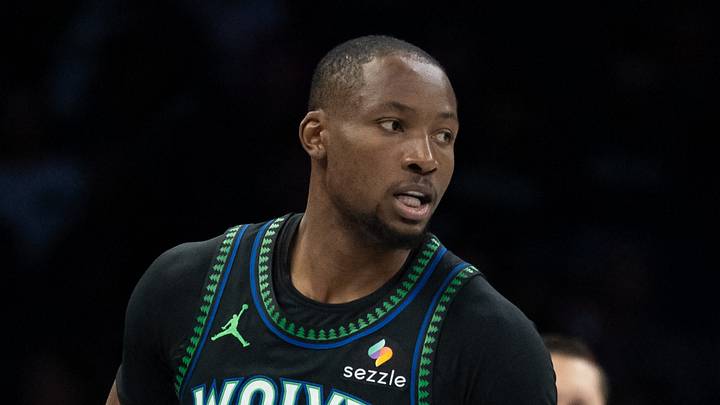
Earlier this week, Minnesota Timberwolves head coach Chris Finch said the team would be lost without Jonathan Kuminga. Needless to say, that's extremely high praise. Moreover, Finch is right—Kuminga has filled in a lot of gaps for this team. He has done a wonderful job guarding physical forwards, crashing the glass, and providing the Wolves with solid offensive versatility.
Had the Wolves not signed Kuminga, the Wolves' power forward position would be in a far worse spot, and they certainly wouldn't have a 7-3 record. However, the reality is that signing Kuminga wasn't supposed to happen. The Wolves were nearing the second apron and only gained access to the taxpayer mid-level with some financial maneuvering.
With more lucrative offers available from other teams, signing Kuminga felt like a long shot at best. Still, Tim Connelly and company found a way to make it work. And thank goodness they did, because, as Finch said, they'd be lost without him.
Jonathan Kuminga has been an essential part of the Timberwolves' success
Before exploring the alternative reality of what things would look like without Kuminga, I want to dive further into his impact. Kuminga solved a major need for this team as someone who can guard physical forwards. Not only was this a need for the Timberwolves after trading Julius Randle and Naz Reid, but it's a skill that neither Randle nor Reid offered at the same level Kuminga does.
Through two games, we've seen the value of Kuminga's skill set against Zion Williamson, Scottie Barnes, Evan Mobley, Giannis Antetokounmpo, and Paolo Banchero. Kuminga's defense against Zion was especially stout, as he held Big Z to 2-for-6 shooting when defending him. Furthermore, Williamson's 13 points were a career-low against the Timberwolves.
Frankly, few players can guard physical forwards as well as Kuminga can, and the ones who can certainly weren't available.
Even after signing Kuminga, it was reasonable to expect the Wolves to struggle on the glass. Despite this, the Wolves haven't just been a solid rebounding team—they've been excellent, leading the league in rebounds per game. Kuminga is averaging 5.9 rebounds and has been a big part of their success on the glass.
Offensively, Kuminga has played a complementary role to perfection. He has punished mismatches when appropriate, cut off the ball, and hit his spot-up 3-pointers at an elite rate (42.6 percent), while never disrupting the flow of the offense. Simply put, he's been vital to the Wolves' success on both ends of the floor, and there wasn't a player available (or on the roster) who could've replicated this skill set.
The Timberwolves would've been in a tough spot without Kuminga
Realistically, the Wolves would have been forced to run a small-ball lineup without Kuminga. They signed him in late August when the free-agent market was super dry, especially at the power forward position. Kevin Love and Kelly Olynyk were realistic alternatives. Neither of these players is currently in the league, nor would they provide high-quality minutes.
Given the Wolves' payroll and lack of future draft picks, a trade was unlikely. There was no way for the Wolves to address this need with a starting-level player besides Kuminga. As such, the Wolves would have patched together this position. Trey Lyles would've been the team's only true power forward. Jaden McDaniels, Terrence Shannon Jr., and Jaylen Clark would all spend some time guarding fours, which simply isn't their game.
Lyles has been a productive backup, but he doesn't have the athleticism to keep up with high-end forwards on defense. McDaniels is fantastic at the point of attack, but it's unclear if he has the strength needed to defend physical forwards. Clark is in a similar boat. Shannon has shown some defensive improvement, but he's not a natural forward.
The Wolves' offense might've been fine without Kuminga, but their defense and rebounding would've struggled. They certainly wouldn't be off to such a strong start, nor would they be as viable in a playoff setting. Whatever way you slice it, signing Kuminga helped the Timberwolves avoid having a major roster flaw.
 Add us as a preferred source on Google