

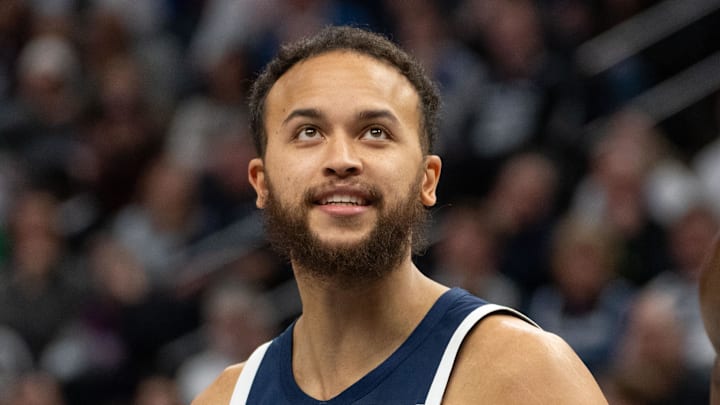
Kyle Anderson's return to the Minnesota Timberwolves has been well-received by fans. We'll have to see what level of impact Anderson has starting on Tuesday night against the Memphis Grizzlies. Nevertheless, it's fair to expect he'll earn some rotational minutes.
Perhaps the biggest advantage of Anderson's return is the extra versatility and optionality he provides. Before bringing Anderson back, the Wolves were likely locked into an eight-man rotation with Naz Reid, Ayo Dosunmu, and Bones Hyland as the three bench players.
Now, they have the option to go nine deep or utilize an eighth man based on matchups. Frankly, certain matchups are more advantageous for Anderson while others are more advantageous for Hyland. This optionality is a massive benefit for the Timberwolves, and it could be a subtle factor that helps them reach their ceiling.
Dane Moore recently pointed this advantage out on his podcast.
"I think it's just he's (Chris Finch) not going to be able to resist playing Kyle. And I think that'll be justified even in a playoff series if it's a matchup that makes more sense for him to play than Bones, which thatexists. And the opposite exists as well, as you as you mentioned with the Phoenix thing, it's a really good option to have, I think," Moore said.
Anderson gives the Timberwolves some much-needed lineup optionality
Traditionally, teams shrink their rotation in the playoffs, so depth doesn't matter as much. Nevertheless, in recent years, depth has become more important. It helps teams withstand possible injuries and better match their opponents' style of play. Think of the last two teams to make the NBA Finals, the Oklahoma City Thunder and the Indiana Pacers; both teams had strong depth and lineup optionality. In 2024, the Boston Celtics had some impressive depth and lineup options as well.
Simply put, depth is becoming more important for teams to win at the highest level.
Frankly, this has been something that the Wolves have lacked this season. Regardless, Anderson's arrival and Dosunmu's earlier arrival change things in a big way for the Timberwolves.
With Anderson now, the Wolves have nine players who can feasibly play sizable minutes in the playoffs. Two years ago, we saw Anderson's role in the Wolves' rotation fluctuate based on matchups in the playoffs. All in all, he played 15.4 minutes a game. However, Anderson averaged just 10 minutes (and got a DNP-CD) against the Phoenix Suns in the first round, while later playing 22.4 minutes in the conference finals against the Dallas Mavericks.
In all likelihood, the Wolves will play one of the Houston Rockets, Los Angeles Lakers, or Denver Nuggets in the first round.
The Rockets' strong positional size and physicality could pose a difficult matchup for Bones, paving the way for more Anderson minutes. Conversely, the Lakers lack size and perimeter defense, which favors Bones. The Nuggets could open the door for a nine-man rotation. Bones has had success against them, and the Wolves could also benefit from another defender to throw at Nikola Jokic.
Ultimately, signing Kyle Anderson wasn't a move that garnered national attention, but in the end, his extra versatility and depth could be a real difference maker.
 Add us as a preferred source on Google