

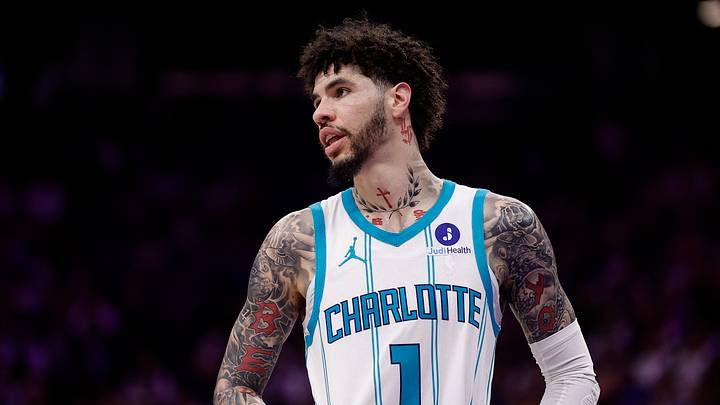
Appearing in two out of the last three conference finals, the Minnesota Timberwolves are on the brink of a championship run. With Anthony Edwards, Jaden McDaniels, and Rudy Gobert, they have a nucleus that has proven to be capable of playoff success. Heck, I'd throw Ayo Dosunmu in there as an impactful complementary guard.
However, four players aren't enough to win at the highest level, and there are some Wolves players who still need to prove themselves in their respective roles. Whether it's star-level players like LaMelo Ball (as noted in the headline) or young, unproven players, there are several Timberwolves who need to prove themselves for this team to reach its championship aspirations.
LaMelo Ball

I've defended the LaMelo trade from the Wolves' perspective countless times. However, it's certainly a risk given Ball's injury history and lack of experience in high-leverage situations. The Timberwolves are betting that LaMelo will get them over the championship hump. Talent-wise, that's more than a reasonable proposition. And last season, he was the driving force of an elite Hornets offense, which should negate some of the concerns about his ability to contribute to winning basketball.
Regardless, Ball has played in just 60 games twice in six years, and he has never touched the court in the playoffs. As such, Ball needs to prove that he can stay healthy and handle the physicality of a playoff setting. Furthermore, while I think the concerns about contributing to winning basketball are overblown, some of his daring shot selection could be improved upon.
Given some of the uncertainty about Ball and that the Wolves view him as the final piece to their championship hopes, he has the most to prove on the team and maybe the whole league.
Joan Beringer

By trading both Julius Randle and Naz Reid, there's a clear runway for Joan Beringer to earn regular minutes. Not only that, but the Wolves' offseason reflects a ton of belief in Beringer. In limited court time last year, Beringer showcased his upside as a rim protector and lob threat. I believe he can rise to the occasion and help the Timberwolves stay afloat when Rudy Gobert is off the floor. Still, counting on a second-year big man who just started playing basketball in 2021 as your lone rotational big man has clear risks.
Even if Beringer produces in the regular season, it'll be fair to wonder if he can thrive in the playoffs, when it counts for the Timberwolves. And as currently constructed, he's their lone backup big man, so they may have no option if he's not ready for high-leverage hoops.
There are plenty of reasons to be excited about Beringer, especially long-term, but he'll have to prove he's ready for the role Minnesota is counting on him to play this season.
Terrence Shannon Jr.

While Terrence Shannon Jr. came to life at the end of the regular season and playoffs, it was anything but an ideal second season. Shannon was viewed as the Timberwolves' primary replacement for Nickeil Alexander-Walker. Unfortunately, he struggled to remain a consistent part of the rotation, averaging just 12.5 minutes per game.
Chris Finch admitted that he shouldn't have used Shannon off the ball so much. Yet the question looms: Is Shannon dependable enough to justify heavy on-ball usage? If he's not, it remains unclear if Shannon can thrive in an off-ball complementary role.
With the Timberwolves' uncertainty at the power forward position, it's easy to connect the dots and suggest that Shannon could fill this void. Despite this and his athletic gifts, the reality is that his defense has been underwhelming at the NBA level. As such, Shannon has plenty to prove on both ends of the floor.
Bones Hyland

Last season, Bones Hyland proved that he's a legitimate NBA player. Beforehand, he was nearly out of the league. What remains unclear, though, is whether he's a legitimate playoff contributor.
After a feel-good regular season, Hyland saw a diminished role in the playoffs despite the Timberwolves dealing with injuries. Notably, Hyland averaged just 11.6 minutes and 4.6 points while shooting just 30 percent from the field in the postseason. This likely cost him the chance to earn more money on the open market, as he re-signed on a minimum contract.
Hyland is an erratic microwave scorer with a slight frame. Oftentimes, players like this struggle once the postseason rolls around. The bright side is that Hyland could silence this major question about his game and prove that he's a dependable reserve guard.
 Add us as a preferred source on Google