

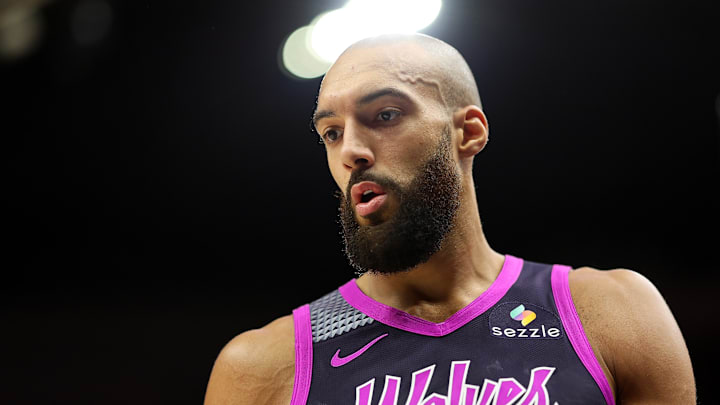
The Minnesota Timberwolves fell short 142-138 in overtime against the Denver Nuggets on Christmas night. There is a lot to discuss with this game, including Anthony Edwards' 44-point performance and insane corner 3-pointer to force overtime and Nikola Jokic's godly 56-point, 16-rebound, 15-assist stat line.
ARE YOU KIDDING ME, Æ!?!?!?!
— Minnesota Timberwolves (@Timberwolves) December 26, 2025
ALL-STAR THIS MAN.
🐜 » https://t.co/PycQA58rBr pic.twitter.com/FIc8DvDl2g
However, I'd like to focus on the Wolves' defense, specifically the stark difference between when Rudy Gobert was on the court vs. when he was off the court. The non-Rudy minutes have been a major problem for the Wolves all season long, but I don't think any game better captures it than this one, and it's fitting that it happened on a national stage.
In the 34 minutes that Gobert was on the floor, the Wolves posted an impressive 98.6 defensive rating (a number that translates to the best defense in the league) and a 157.4 defensive rating without him (a number that is 33.1 more than the league's worst defense). A on/off swing this immense is simply unfathomable, and frankly, it shouldn't be real.
Nevertheless, if you've watched the Timberwolves all season, this on/off swing doesn't even seem like that much of a surprise. From a plus-minus standpoint, they were a plus-22 with Gobert on the court and a minus-18 without him.
Timberwolves with Rudy Gobert:
— Kevin O'Connor (@KevinOConnor) December 26, 2025
+18 in 34 minutes
Timberwolves without Rudy Gobert:
-22 in 19 minutes
Same old story. Minnesota needs to figure out how to survive without Gobert on the floor or there’s no chance this team takes the next step.
The non-Rudy minutes are costing the Timberwolves in a big way
While a 58.8 single-game on/off swing is otherworldly even for Gobert, maintaining defense without him isn't a new problem for the Wolves. Gobert entered Thursday's game with a 13.8 defensive rating on/off swing, which ranks in the 98th percentile per Cleaning the Glass. After the game, this jumped up to a league-leading 16.1 on/off swing.
Gobert was tied for the least amount of minutes among the Wolves' starters due to foul trouble, which ultimately caused him to sit out at the end of overtime. This foul trouble made the Wolves' lack of defense in the non-Gobert minutes more noticeable.
When Gobert sat after picking up his fourth foul midway in the third quarter, the Wolves were down by eight when he returned to start the fourth; they were down 14.
In terms of basic counting stats, Gobert notched six blocks, marking a season-high. He gave the Wolves a sliver of hope against the all-mighty Jokic. With Gobert, the Wolves had a clear identity and plan to stop Jokic. They would put a smaller defender (mostly Jaden McDaniels on Jokic), and Gobert would roam down low.
This is similar to strategies the Wolves used against Jokic and the Nuggets in the past. Listen, Jokic is always going to get his, but it was clear Gobert was helping slow him and the Nuggets' offense down.
Huge rotation from Julius Randle here for Minnesota. Edwards on Murray, McDaniels on Jokic, that P&R is a switch. Gobert is roaming to help and hits. Jokic skips to the corner but look at the effort from Randle to close out to THJ on the wing and take a clean look away. pic.twitter.com/AFspKeVFKa
— Steve Jones (@stevejones20) December 26, 2025
Without him, though, the Wolves were lost; they had nobody to replicate his impact as a rim protector and roamer without sacrificing McDaniels' on-ball abilities. That's been a problem all year; the system is built around Gobert's elite rim protection, and they have nowhere to turn when he sits.
I also didn't love Chris Finch's rotations; there were far too many times in the non-Rudy minutes where both McDaniels and Clark were on the bench.
If the Wolves hope to solve this common issue, they must pair McDaniels and Clark, or at the very least play one when Gobert is off the court. Notably, with McDaniels and Clark but without Gobert, the Wolves have a respectable 111.7 defensive rating, which is an improvement from their overall 123.6 DRTG without him.
The Wolves are the fifth-ranked defense via Cleaning the Glass. However, this is largely due to Gobert's excellence, and if they don't figure out the non-Rudy minutes, it will massively hurt them.
 Add us as a preferred source on Google