

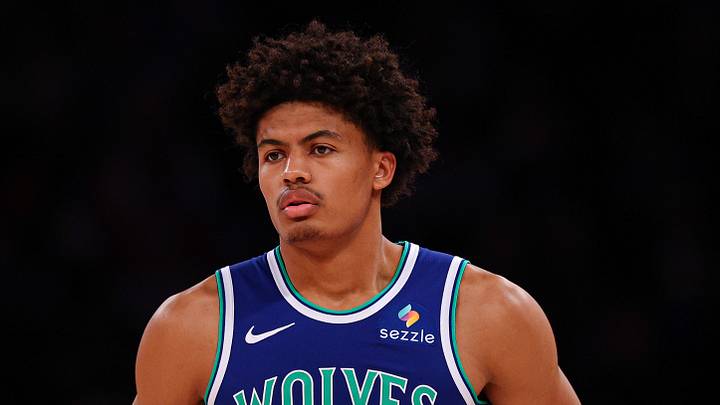
The Minnesota Timberwolves are full of youth, with only two players above the age of 30. However, their starting lineup is filled with fairly established players (even if LaMelo Ball and Jonathan Kuminga have to prove themselves).
On the other hand, the Wolves' bench outside of Ayo Dosunmu is filled with unproven yet talented young players. For the Timberwolves to reach their ceiling, they'll need growth from these guys.
With that in mind, here's one area of growth for each young bench player that can help maximize their impact and/or solidify their spot in the rotation.
Joan Beringer: Basketball IQ
Of this bunch, Joan Beringer is the most important player to the Timberwolves' success, since they lack frontcourt depth. At 19 years old, he has a ton of upside, but he also has a lot of areas for growth. Beringer's foul trouble has been the most discussed. Notably, he averaged 5.4 fouls per 36 minutes as a rookie.
What I don't think has been discussed enough is that he's often found out of position on defense. This is a key reason for his foul trouble, and he often gives up shots at the rim due to his defensive positioning. The common thread between these issues is basketball IQ. Beringer only started playing basketball in 2021, which explains these lapses.
Beringer will get better with more reps, but for him to unlock his defensive upside and utilize his athletic tools, his basketball IQ must improve.
Terrence Shannon Jr.: Complementary skills
The Wolves have discussed empowering Terrence Shannon Jr. on the ball all offseason. Still, the Wolves have too many established offensive creators, and Shannon struggles with control as a driver. You could argue Shannon needs to improve as an on-ball scorer, but I think he needs to establish more complementary skills.
Ultimately, his best chance to carve out a role with the Wolves is being a true complementary player, not a high-usage guy. Unfortunately, Shannon's spot-up shooting has been poor throughout his career, and he has far too many defensive lapses. Last season, he shot just 33.3 percent from 3-point range, and the Wolves' defense was 13.9 points per 100 possessions worse with him on the court, according to Cleaning the Glass.
Being able to offer some level of creation, solid spot-up shooting, and defense is the best-case scenario for Shannon. He has plenty of work to do, though.
Bones Hyland: Dealing with physicality
Bones Hyland has been in the league since 2021, but he's still just 26 (technically, he's a few months younger than Shannon). He had a career resurgence with the Timberwolves last season, averaging 8.6 points per game. Hyland's scoring and pace gave the Wolves a boost. At 6-foot-2 and 169 pounds, though, Hyland's frame isn't ideal in the modern NBA.
Whether it's dealing with tough perimeter defenses or surviving on defense, Hyland's ability to play in physical settings is a concern. In the playoffs, this led to him being hunted on defense, and he struggled to score at an efficient clip, shooting 30 percent from the field. Hyland faces an uphill battle as a small guard, but he must show that he can hang against physical teams to be anything more than a deep rotation player.
Jaylen Clark: 3-point shooting
This one is easy. Jaylen Clark's defense is well above average. He is a tenacious on-ball stopper, with strength to guard up and an ability to be disruptive off the ball. Regardless, his offense is a glaring red flag. Clark shot just 32.7 percent from beyond the arc last season. Because of his limited self-creation and playmaking abilities, Clark's offensive role is primarily spot-up shooting.
If he can't shoot 3-pointers, though, then the Wolves are essentially playing four-on-five whenever he's on the court. For this reason, he'll likely start the season outside of the rotation. However, I still think he'll get an opportunity for some spot minutes at some point this season, and if he knocks down his open 3s, then he could be a rotational mainstay.
Cody Williams: 3-point shooting
Cody Williams falls into a similar bucket to Clark. Williams is a rangy, plus-sized point-of-attack stopper who has offensive deficiencies. While Williams showed improvement on offense last season with the Utah Jazz, his shot didn't come around, as he netted 21.4 percent of his 3-pointers. Yikes.
Much like Clark, it doesn't matter how good a defender Williams is if he can't make defenses play for leaving him open. The Wolves could use some extra wing/forward minutes off the bench, and if Williams shows growth as a shooter, he could play a role. Based on how his career has played out, though, that's a big if.
Isaiah Evans: Secondary skills
Isaiah Evans won't crack the Timberwolves' rotation this season. There's simply no clear spot for the rookie given the Wolves' backcourt depth. Still, he'll likely spend a good chunk of time in the G League, which could help him immensely. Evans enters the league as a specialist. He is a good 3-point shooter, but doesn't offer any more NBA skills.
And yes, I get it—his shot looked shaky in preseason and summer league, but he was an elite shooter in college, so I'm not concerned about that. What worries me long-term is how Evans will impact the game outside of shooting. He's not a strong playmaker, he doesn't have a super tight handle, isn't a high-level creator, and his lack of strength puts him at a disadvantage on defense.
Specialists are a dying breed in the ever-so-versatile NBA. Therefore, Evans will have to develop another bankable NBA skill to crack the rotation next season.
 Add us as a preferred source on Google