

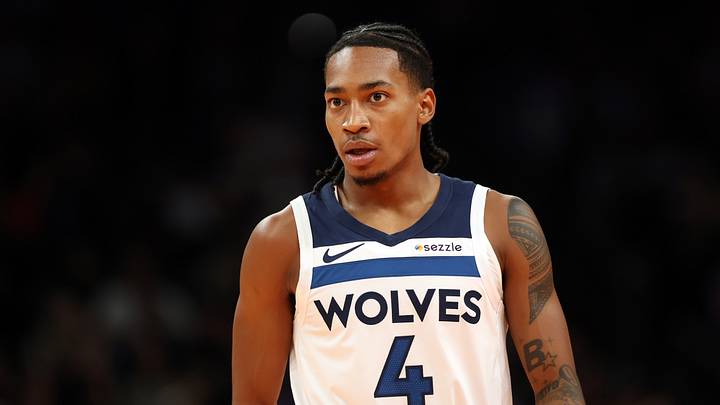
The Minnesota Timberwolves have hit on a lot of big moves during Tim Connelly’s tenure as president of basketball operations. However, one of his major whiffs was a trade to acquire Rob Dillingham during the 2024 NBA Draft.
After sending an unprotected 2031 first-round pick and a pick swap in 2030 to the San Antonio Spurs to select Dillingham with the eighth overall pick, the young point guard never earned a consistent spot in Chris Finch’s rotation before he was traded to the Chicago Bulls in part of a package for Ayo Dosunmu last February.
Even though the trade didn’t work out, there are still lessons to be learned with the move. And Finch believes one of them involved placing too many expectations on a young player to contribute immediately in the same way the Minnesota Vikings did with J.J. McCarthy.
“I do know they’ve had a lot of volatility at the quarterback position, which, you know, I think [Vikings head coach Kevin O’Connell] has done a remarkable job…of navigating that. And we know how important that position is,” Finch said during an appearance with Paul Allen on KFXN. “We’ve had similar issues in and around the point guard, as Mike Conley, who was incredible for us but got to the end of his run.
“I see some parallels there, and what you expect of a young point guard. Like, what we expected of Rob Dillingham was probably too much and unfair given where we were, given where he was at the time, and what we needed and what he needed. Maybe there are some parallels there to J.J. as he continues to try to find himself.”
The Timberwolves placed too much, too soon on Rob Dillingham
For the Timberwolves, it’s clear to see where the expectations came from. The Wolves had just been to the Western Conference finals but needed an upgrade at point guard as Conley began to age out. With limited assets to go get a solution in free agency, the Wolves were aggressive in the draft, trading up for Dillingham with the expectation he would acclimate himself quickly with his ability to create shots and make plays.
Unfortunately, Dillingham was a raw prospect. Listed at 164 pounds during the NBA combine, Dillingham didn’t have the strength to acclimate to the NBA level, and his defense was a work in progress. With Mike Conley, Donte DiVincenzo and Anthony Edwards also in the backcourt, playing time was hard to find, and the decision was made to trade him midway through his second season.
Dillingham’s departure makes him another in a long line of Timberwolves’ draft busts. But it also sounds similar to what the Vikings realized with McCarthy.
Selected with the 10th overall pick in the 2024 NFL Draft, McCarthy’s rookie season was wiped out due to a torn meniscus suffered during the preseason. But the hype intensified as the Vikings won 14 games, let Sam Darnold leave the following offseason and turned down Aaron Rodgers during free agency. With that, McCarthy was expected to be NFL-ready out of the jump to lead a team with championship expectations, but he flopped in a big way as he got hurt, played poorly, and the Vikings limped to a 9-8 record.
In both cases, Minnesota teams learned the hard way that's it's hard to trust young raw players to have a big role on a winning team.
The Wolves recovered masterfully from their Rob Dillingham mistake
Both teams swung and missed to fill a key void, but the biggest thing is what teams can learn from it. The Vikings went ahead and signed Kyler Murray and installed him as the starter to replace McCarthy. But McCarthy could still pan out, either working behind the scenes or benefitting from the change of scenery Dillingham got when he was traded to the Bulls.
The Wolves also took the same approach, deciding to trade for LaMelo Ball this summer. At 26 years old, Ball is an established point guard in the same way that Murray is a veteran signal-caller, and both players step into important roles on teams expecting to chase a championship in their upcoming seasons.
If anything, the Wolves also get bonus points for finding a solution in his prime, as Ball will turn 25 on Aug. 22. With multiple seasons left in that prime, it could be the long-term solution that many thought Dillingham would be and keep Minnesota from diving into the retread bin like the Vikings probably will if Baker Mayfield or Mac Jones become available in free agency next spring.
For a team not afraid to take risks, the failed Dillingham experiment is something they can learn from, and the Wolves are hoping they’ve found a more suitable solution after acquiring Ball.
 Add us as a preferred source on Google