

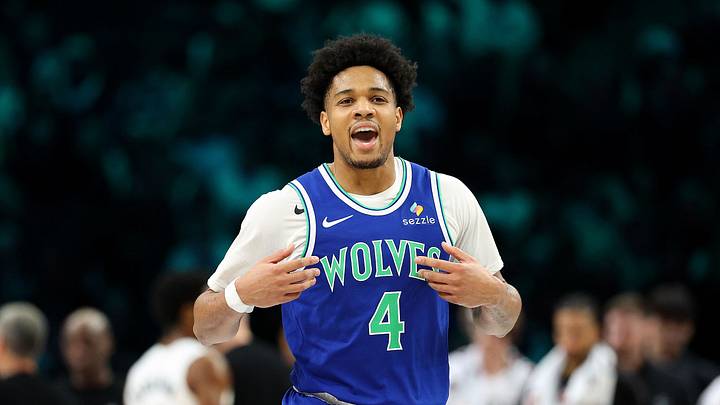
This offseason, the Minnesota Timberwolves made their belief in Terrence Shannon Jr. clear. In June, Chris Finch talked about how important it is to put the ball in Shannon's hands.
"I think we finally found the best deployment of him (Shannon). He definitely needs the ball in his hands more. I think he can play well alongside Anthony as the primary ball handler," Finch said.
Honestly, I was skeptical of the vision, especially after the LaMelo Ball trade. In his first two years, Shannon had flashes of brilliance on the ball, including in the 2026 playoffs. Regardless, the Wolves' plethora of on-ball players, Shannon's inability to control himself on drives, and subpar complementary skills made me dubious.
Thankfully, he's proven the Wolves right and me dead wrong. So far, Shannon is averaging 12.9 points, 3.5 rebounds, and 2.9 assists with 46.3/39.2/80 shooting splits. Shannon has improved both as an on-ball creator and a complementary weapon. In turn, he has found his footing in the Wolves' rotation after a rocky start to his career.
Terrence Shannon Jr.'s growth is helping prove the Timberwolves right
Primarily, Shannon's value is as a bench scorer, and that backs up the Wolves' belief in him as an on-ball creator. Of course, his signature performance was a 34-point game last week against the Portland Trail Blazers. However, Shannon has been a consistent source of bench offense all season, scoring double-digit points in 11 out of his 14 games.
Shannon has done so with a 22 usage rate, while ranking in the 85th percentile for on-ball usage per Databallr. While Shannon has always had physical tools with his size, strength, and speed, his rim finishing has been inconsistent due to his lack of control and left-hand reliance.
Fortunately, Shannon has taken strides, particularly in the control department; this has helped him get to the rim more and finish with more efficiency. According to Databallr, Shannon ranks in the 91st percentile for rim attempts per 75 possessions and is shooting 64.1 percent at the rim. For context, last season he ranked in the 80th percentile and shot just 58.3 percent at the rim.
Shannon's improved control has also helped him as a playmaker. He is more consistently looking for (and finding) shooters when he attacks the basket. Sure, his playmaking hasn't been perfect all the time. For the most part, though, his playmaking has been sharp. Even when he's not driving to the basket, Shannon has been a more willing playmaker. Impressively, Shannon's assist percentage has increased from 9.5 to 17.9.
To me, it was always clear that Shannon needed to improve as a passer to justify an on-ball role on such a talented team. And he's doing exactly that.
Shannon's improved on-ball chops are the main reason that he is validating Minnesota's belief in him. Nevertheless, Shannon's improved complementary skills give him some scalability.
His defense both on and off the ball has improved immensely. Plus, Shannon is shooting 46.7 percent on catch-and-shoot 3-pointers, a sizable increase from 33.3 percent last season. These improved skills as a 3-point shooter and defender allow him to fit alongside Minnesota's established talent even when he doesn't have it going offensively.
Both as an on-ball creator and a complementary wing, Shannon has proven his worth. It's safe to say that the Timberwolves were right to believe in Shannon and empower him on the ball.
 Add us as a preferred source on Google