

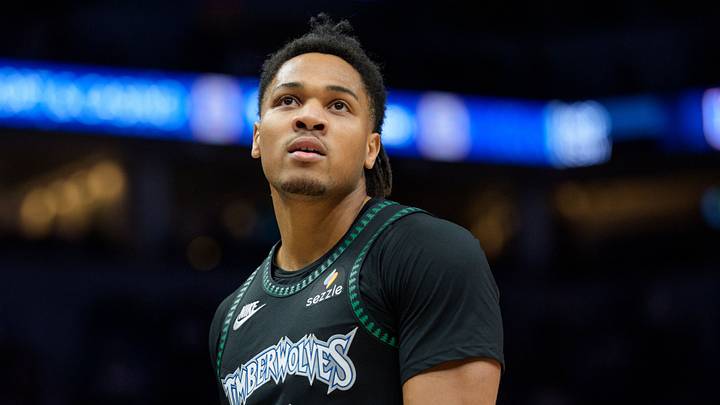
It's been a rocky two years for Terrence Shannon Jr., who has never found a consistent role in the Minnesota Timberwolves' rotation. He's flashed his upside as a downhill scorer and overall shot creator, especially in the playoffs, where he averaged 11.8 points this past season.
The dilemma with Shannon is that he's much better on the ball than off the ball. Chris Finch openly admitted this during the playoffs. Regardless, it's unclear whether Shannon is truly skilled enough on-ball to be empowered in this role, particularly given how much established talent the Timberwolves have.
As such, there are two paths for Shannon to become a vital part of the Wolves' rotation: he either needs to further develop as a creator or become much better in a complementary role. Frankly, if one of these things doesn't happen, that could be the end of the road for his tenure with the Wolves.
Shannon is a good player, but not a good fit with the Timberwolves
To be clear: Shannon is still a useful player. However, last season made it clear that he thrives in an on-ball role, and I don't see how the Timberwolves can grant him this opportunity.
LaMelo Ball, Anthony Edwards, Jaden McDaniels, Jonathan Kuminga, and Ayo Dosunmu will all have more on-ball duties than Shannon. Maybe Shannon can take away creation duties from the latter three players. Still, McDaniels deserves more usage, and Dosunmu is a gifted downhill scorer.
And while Shannon is a skilled creator, he's a flawed one. Most notably, his right hand is non-existent, and he can get tunnel vision.
If the Wolves can't find enough on-ball usage for Shannon, his role could be diminished, just like it was last season. While Shannon shot 40 percent from 3-point range overall, he netted just 34 percent of his catch-and-shoot 3s. This, in tandem with shaky playmaking and lackluster defense, makes him struggle immensely in a pure complementary role.
Improvement in these areas, or as a shot creator, can't be ruled out. Without ample improvement, though, Shannon will quickly become a prime trade candidate.
Again, without growing a ton, Shannon can still be a good player in a microwave scorer role; that's just not a void the Timberwolves have.
The Wolves must ask themselves: Is Shannon a long-term part of the future? And if the answer is no (which feels possible depending on his growth), then they should trade him at the deadline.
Given the flashes of brilliance that Shannon has shown, it's fair to expect him to have some interest across the league. The Timberwolves could add a similarly intriguing yet unproven young player at a position of need (like third-string center), or they could bolster some of their non-existent draft capital (even if it would just second-round draft capital).
Overall, Shannon enters this season at a crossroads, and if he doesn't improve, he could find a new home sooner than expected.
 Add us as a preferred source on Google