

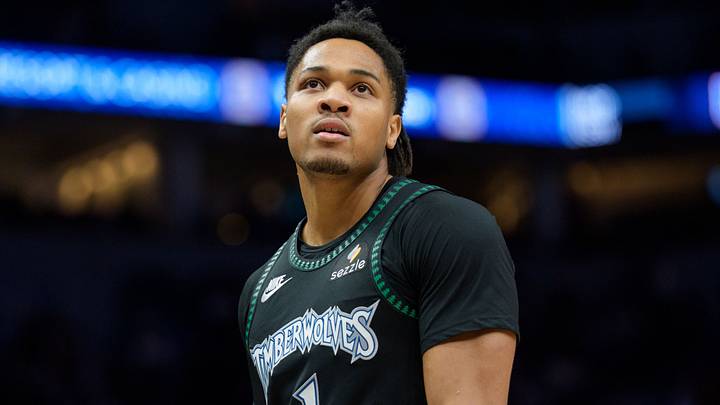
The Minnesota Timberwolves have had a busy summer, but for all the excitement surrounding their moves, it wouldn’t be surprising if Terrence Shannon Jr. felt a little disappointed. The third-year guard felt like he was going into the offseason with momentum after thriving in a role with the ball in his hands, and even head coach Chris Finch felt like that was the best option moving forward. But with a small army of players who are at their best on the ball, Shannon may have to lean on his defense to earn his playing time.
Shannon has been a defensive liability, as the Timberwolves' defense was 13.9 points per 100 possessions worse when he was on the court last season. While he was the inverse of Rudy Gobert on defense, he may have the tools to succeed based on intel from Wolves podcaster Dane Moore.
“There was a team preparing to play another team in the postseason and they were going through film of how to defend this team on the perimeter. And I know this scout from the team, and he sent it to me, and he said, ‘We actually were showing our group a lot of Terrence Shannon Jr. film,” Moore said on the latest episode of The Dane Moore Podcast.
“Guarding on the perimeter, fighting through pin downs…it was basically [him] saying ‘He did a really good job and we wanted to show this to our players of going from navigating a screen, off ball, getting around it and engaging into ball containment. And it was good enough that they were literally showing clips to their group of Terrence Shannon Jr. and the way he was navigating.”
Defense could be the best way for Terrence Shannon Jr. to earn minutes next season
The fact that Shannon Jr. was used as a defensive example is encouraging. But it’s also surprising considering how much he’s struggled on that end of the court. According to tracking data from NBA.com, opposing players shot 51.4 percent on defended field goals when Shannon was the primary defender. Players also shot 46.5 percent when Shannon was on the floor, creating a 4.9 percent benefit for opposing shooters when Shannon was the primary defender.
Basketball Index's analytics also didn’t do him any favors, with a variety of Ds and Fs for his performance. But the one saving grace was his performance as an off-ball chaser, which is something that supports Moore’s observation that Shannon’s effort isn’t the problem.
Stat | Value | Percentile | Grade |
|---|---|---|---|
Perimeter Isolation Defense | -0.60 | 38% | D+ |
Ball Screen Navigation | -0.76 | 27% | D |
Off-Ball Chaser Defense | 0.11 | 64% | B- |
Pickpocket Rating | 0.07 | 12% | F |
Passing Lane Defense | 2.78 | 36% | D+ |
“I don’t think we’ve viewed him as a great defender, but there is a tenacity to Shannon as a defender,” Moore continued. “He gets into you. …I don’t know exactly what they were showing there, but that’s kind of always stood in the back of my mind, because I’ve always sort of thought, like physically, I think Shannon could be a good defender. I don’t see him being a passive guy.
“I think it’s some of the thinking stuff defensively, or overly speeding himself up defensively, that got him out of position. I mean, he doesn’t have good numbers, but I think if we isolate it a little bit, and I remember at that time, when the guy sent me the clips, and I was like ‘Oh, yeah. You know, if I was just watching this I’d be like, yeah, that does look like how I should be defending on the perimeter there. So I hold out some optimism for Shannon just because I think he has some higher upside.”
Between Shannon's willingness to play sticky on-ball defense, his physical gifts, and his ability to chase shooters, he has some real defensive upside.
Looking at the Timberwolves’ roster, improving defensively – along with his catch-and-shoot percentages – may be Shannon’s best way to get on the floor. Minnesota has plenty of players who can create with the ball in their hands. While it gives LaMelo Ball and Anthony Edwards options as backcourt mates, it creates a “too many mouths to feed” scenario, especially when Shannon is on the floor.
This means that Shannon has to impact the game in other ways and defense could become his calling card with the fundamentals in place. Cutting down on the mental mistakes and aggressiveness at times could be one way to find improvement and it’s something that Finch called Shannon out for after the Timberwolves’ loss in Game 5 of their first round series against the Denver Nuggets last April.
“It starts with [he’s] gotta be ready, he’s gotta be engaged, he’s got to be fully committed to that side of the ball,” Finch said. “...He knows what we need from him right now. So he’s got to be ready, and he’s got to be ready to execute defensively, and there’s no reason he shouldn’t be a good defender with his body type and athleticism.”
While Shannon responded with a big two-way effort in Game 6, continuing that trend could help him earn a bigger role and separate himself from Jaylen Clark. Clark excels defensively but only shot 43.4 percent from the floor and 32.7 percent on 3-pointers last season, compared to Shannon’s 45 percent shooting overall and 40.8 percent shooting on 3-pointers. Shannon also has a size advantage at 6-foot-6 and 215 pounds compared to Clark’s 6-foot-5, 205-pound frame, and if he continues to shoot well, that could be enough to earn him more minutes.
Shannon already takes his work seriously on the defensive end, and the fact that teams used tape of him defending could mean there is something to work with.
But until Shannon consistently puts it on the court, he may have trouble finding minutes on a Timberwolves bench that is already more crowded than it was a year ago.
 Add us as a preferred source on Google