

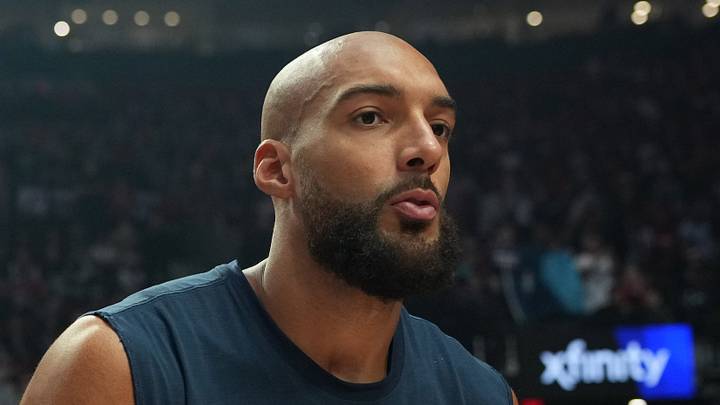
After boasting one of the biggest frontcourts in the NBA the past two years, the Minnesota Timberwolves are making a big shift ahead of the 2026-27 season. Trading Julius Randle and Naz Reid has left a big hole next to Rudy Gobert. Minnesota is hoping that a committee approach can help them bridge the gap in the Western Conference. Jaden McDaniels and Trey Lyles are the team's only true forwards. While Terrence Shannon Jr., Josh Green, and Jaylen Clark are candidates to shift up.
The gamble is neutralized by a star-studded backcourt that features Anthony Edwards and LaMelo Ball. But it could leave the Wolves vulnerable to a few teams that have the size to create problems for Minnesota next season.
With the NBA schedule dropping this week, let's take a look at which matchups will put the most pressure on the Timberwolves.
Oklahoma City Thunder
Matchup dates: 11/25/26, 12/25/26, 3/2,27, 3/28/27
The Thunder are one of two teams standing in the Wolves' way, and while the San Antonio Spurs have Victor Wembanyama, Oklahoma City poses an even bigger threat with the duo of Isaiah Hartenstein and Chet Holmgren.
Hartenstein has the size to battle Gobert at seven feet and 250 pounds. While he hasn’t put up massive offensive stats, his 9.2 points per game were complemented by 9.4 rebounds per contest, giving the Thunder plenty of muscle in the paint.
But Holmgren also gives the Thunder plenty of length with a 7-foot-6 wingspan. That length helps the Minneapolis native on the defensive end of the floor, but so does his athleticism, which can help him guard players on the perimeter and also allowed him to post 17.1 points and 8.9 rebounds per game last season.
Holmgren’s stats were slightly down from his season average with 15.5 points and seven rebounds per game in their four meetings. But that was with Randle in the paint and will now be replaced with McDaniels or Lyles, who each check in at 6-foot-9. The Thunder also love experimenting with their lineup, but if they want to go big, the Timberwolves will have their hands full.
Houston Rockets
Matchup dates: 11/4/26, 1/5/27, 1/20/27, 4/11/27
Kevin Durant has been a mismatch for any team during his career, but he may have a bigger advantage against the Wolves frontcourt next season. While he’ll turn 38 in September, Durant still got it done in his first season with the Rockets, putting up 26.0 points, 5.5 rebounds, and 4.8 assists per game.
While those numbers are impressive, the biggest advantage is his shooting. Durant shot 52 percent from the floor last season, but his 41.3 percent clip from 3-point range creates plenty of floor spacing for center Alperen Sengun.
Sengun is on the back end of back-to-back All-Star appearances and could have three straight after averaging 20.1 points, 9.5 rebounds and 5.4 assists over the last three seasons. But he’s been a problem for the Timberwolves as well, averaging 20.7 points, 9.7 rebounds and 4.3 assists in 15 career meetings.
The points and rebound averages are Sengun’s highest against Western Conference opponents and the Wolves’ lack of size could help him put up bigger numbers going forward. While a smaller lineup allows Minnesota to keep up with Durant, they’ll need to be careful not to allow that to create more opportunities for Sengun on the inside.
Denver Nuggets
Matchup dates: 12/28/26, 12/31/26, 1/27/27, 3/7/27
When talking about strong frontcourts, the Timberwolves have to think about the Nuggets. Denver may have been the overall inspiration for the Wolves' decision to trade for Gobert in 2022 as Nikola Jokic was rising to the peak of his powers, and he did it again last season, averaging 27.7 points, 12.9 rebounds and 10.7 assists.
Jokic especially turned up his game when facing the Timberwolves last season, averaging an absurd line of 35.8 points, 15.0 rebounds and 11.3 assists during the regular season, and that included a triple-double on Christmas night, which included 56 points, 16 rebounds and 15 assists.
With that, the Nuggets frontcourt was going to be a problem even if they kept Randle and Reid. But Wolves fans could also argue that Aaron Gordon is an even bigger problem.
Gordon was limited to 36 games last season, but was still productive with 16.2 points, 5.8 rebounds and 2.7 assists. But he is still a threat to shoot from the outside, connecting on 38.9 percent of his attempts last season and 43.6 percent of his attempts during the 2024-25 campaign, and his athleticism puts pressure on Gobert.
With Jokic also averaging 4.5 attempts and shooting 38 percent on 3-pointers last season, the Nuggets are still a threat and will challenge the Wolves’ new-look frontcourt.
San Antonio Spurs
Matchup dates: 10/31/26, 1/3/27, 1/22/27, 2/18/27
If the Timberwolves were looking to model their frontcourt after a contender, the Spurs would likely be it. While they have Wembanyama, their power forward position was a combination of Julian Champagnie and Carter Bryant and got even better after signing Tobias Harris to a two-year, $31 million contract this offseason.
Harris is a similar size to the Timberwolves' frontcourt at 6-foot-8 and 226 pounds. He also can shoot well enough with a 36.6 career 3-point percentage that has helped him average 15.9 points per game over his 15-year career.
While that production is nice, Wembanyama is the biggest issue. In his third season, Wembanyama averaged 25.0 points, 11.5 rebounds and led the NBA for a third straight year with 3.1 blocks per game. He also won his first NBA Defensive Player of the Year Award and likely sparked the Wolves' busy offseason after sending them to Cancun last May.
The Wolves' new frontcourt will have plenty of challenges. But getting past Wembanyama and the Spurs may be the biggest of all.
 Add us as a preferred source on Google