

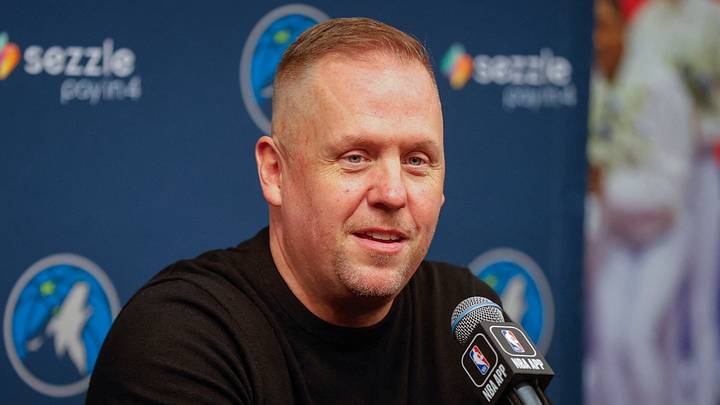
The NFL is in the midst of its trade deadline right now, and if you follow the NFL at all, you've probably seen how the Jacksonville Jaguars are going all-in on their Super Bowl window at this deadline. The Jaguars used to be the butt of every NFL joke, but the new regime has completely turned the franchise around, much like Tim Connelly did with the Minnesota Timberwolves.
Both front offices share characteristics that have enabled their teams to achieve success that the previous regimes couldn't. It starts with being aggressive when it comes to roster building. Both Connelly and James Gladstone, the Jaguars' general manager, haven't been ones to sit on their hands and accept mediocrity. They've recognized when all-in moves need to be made, and they pull them off.
They're also both about bringing in elite culture fits and immediately plugging positional needs. The Wolves needed a point guard this offseason and traded for one of the best in LaMelo Ball. The Jaguars needed a safety and a defensive tackle at this trade deadline, and they traded for two of the best at those positions.
Let's do a deeper dive to see how each organization was able to pull itself out of the mud and the parallels between the teams.
The Jaguars went from back-to-back No. 1 picks to a SB contender
It was bad for a long time in Jacksonville. In 2021 and 2022, they finished with the worst record in the league. From the nightmare head-coach hires like Urban Meyer and Doug Pederson, to consistently giving out bad contracts, and getting extremely complacent with a few wins. Change was needed. In 2025, the Jaguars hired Gladstone to become their new GM, and at 34 years old, he was the youngest in the NFL at that position.
Along with Gladstone, they brought in Liam Coen as their head coach. Since that moment, the Jaguars have had a 19-6 record. They haven't sat on their hands as a front office either. The pieces were in place, but there were roster holes that needed to be filled.
The Jaguars have made splash-transaction after splash transaction in the Gladstone era, notably trading up to select unicorn cornerback Travis Hunter during the 2025 NFL Draft. From then, he would make a bunch of other important moves such as trading for wide receiver Jakobi Meyers, and then at this deadline where he traded for star safety Jessie Bates III and star defensive tackle Jordan Davis.
It's cost the Jaguars a ton of draft capital, but at the end of the day, if you have a championship window, draft picks shouldn't matter if they can be used to greatly improve your team. This is the same mindset that Connelly has in Minnesota.
Tim Connelly has rebuilt the Wolves into a powerhouse
Following the Wolves' first-round exit in the 2022 playoffs, the Wolves hired Connelly. Since then, the Wolves have made the playoffs every season, after making the playoffs only twice since 2004, before his arrival. He immediately put his fingerprints on the team by trading for Rudy Gobert, and while many criticized that trade at the time, it's been a resounding success for Minnesota.
He would then follow up that trade with a flurry of moves in the coming years. Trading Karl-Anthony Towns for Julius Randle and Donte DiVincenzo wasn't a super successful trade, but he needed to do it for salary reasons. He then traded Rob Dillingham, Leonard Miller (who both weren't playing on the Wolves), and four second-round picks for Ayo Dosunmu, who's giving the Wolves All-Star-level numbers this season.
His most recent, and maybe best and most career-defining, move in Minnesota was trading Naz Reid, an unprotected first-round pick, three first-round pick swaps, and three second-round picks for LaMelo Ball. Ball has meshed with this roster perfectly and is exactly the player the Wolves have been missing. All things considered, he got him for a bargain too.
Sure, the Wolves are void of draft capital, but does that really matter when you have a chance to win an organization's first-ever championship? Too many front offices nowadays are too scared to take the big swing, so they settle for good without taking the steps necessary to become great.
The Jaguars and Wolves are two examples of how fortune favors the bold. They've taken risks, and because of those risks, they're better positioned than ever to climb to the mountaintop.
 Add us as a preferred source on Google