

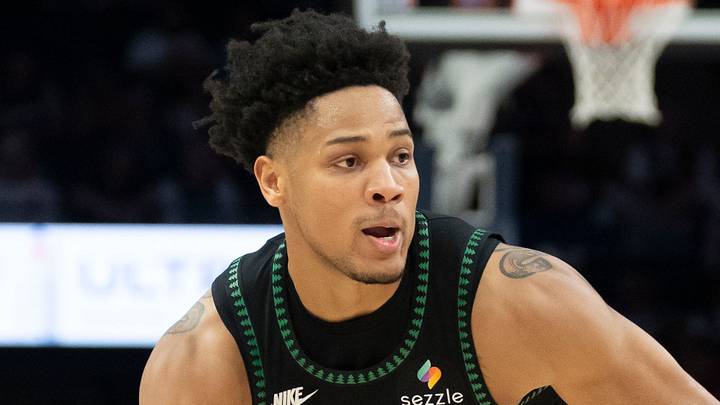
Solely based on their starting five, I don't believe that the Minnesota Timberwolves are significantly behind the San Antonio Spurs and Oklahoma City Thunder. LaMelo Ball, Anthony Edwards, Jaden McDaniels, Jonathan Kuminga, and Rudy Gobert are an incredibly talented group with plenty of two-way balance. Furthermore, Ayo Dosunmu is a stellar sixth man.
Simply put, this top-six gives the Timberwolves a ton of high-end talent, and they could match up with the two Western Conference juggernauts as a result. The problem is that Minnesota has just six proven rotation players; that's not enough to win at the highest level.
That's not to say the rest of their bench stinks. Players like Joan Beringer, Terrence Shannon Jr., and Jaylen Clark could establish themselves as high-end role players this season. However, all of these players are unproven, and if the Wolves' young players don't improve, a title run likely won't be in the cards.
Likewise, it's unclear if veteran power forward Trey Lyles can play real minutes or if Bones Hyland can handle high-leverage minutes. Cody Williams and Isaiah Evans are unlikely to play regular minutes, but they're two young names worth monitoring. There's simply a ton of uncertainty and volatility with the Wolves' bench.
The Timberwolves' depth could be a disadvantage
Conversely, the Spurs and Thunder have an abundance of depth. The Spurs have Dylan Harper, Keldon Johnson, Julian Champagnie, and Luke Kornet, along with less proven yet enticing young players like Carter Bryant and Tarris Reed Jr. Even after trading three rotation-level players, OKC has Ajay Mitchell, Jared McCain, and Alex Caruso, along with three intriguing rookies (Aday Mara, Thomas Sorber, and Bennett Stirtz).
With all due respect, these two teams offer a different level of depth. As such, the Timberwolves are banking on growth from their young players to close the gap (just like last season).
Last season, we saw how the Wolves' bench hurt them. Before trading for Ayo, they had six reliable players, and even after this move, their bench production wasn't up to snuff for a contending team. For the season, they ranked just 21st in bench points, while both San Antonio and Oklahoma City were in the top 10.
Joan Beringer's growth will be key
Beringer is the most important young player for Minnesota. For starters, he's their only true backup big man and thus is guaranteed a sizable role off the bench. Additionally, he has the most upside. Within the context of matching up against the frontcourts of San Antonio and Oklahoma City, Beringer's importance is even more significant.
The good news is that Beringer's upside is immense. He is a freaky athlete who can block shots, switch onto the perimeter, crash the glass, and catch lobs. In limited minutes, he flashed his upside. The bad news is that he's still just 19 years old, has struggled with defensive discipline, and only started playing hoops five years ago. Even if Beringer puts it together in the regular season, he'll have to prove himself in the playoffs.
Minnesota is asking a lot of the young big man, and if he can't put it together, the team will have a depth issue, especially at the frontcourt.
And even if Beringer blossoms in his second year, seven quality players won't be enough to compete in a league that's increasingly favoring depth.
Minnesota needs growth from at least one of Shannon, Clark, or Hyland
Shannon is the team's next most important young player. And frankly, his role is difficult to assess. While Shannon flashed his upside as a downhill scorer in the playoffs, the Timberwolves don't need another on-ball creator, and he hasn't shown that he can thrive in a complementary role.
Look at the players I listed for the Thunder and Spurs; all of them offer skills outside of scoring. At this point, Shannon doesn't. The Wolves will need him to become so good on the ball that they have no choice but to give him on-ball reps, or they need him to become more comfortable as an off-ball player.
Clark is a tenacious defender, but if he can't develop as a 3-point shooter, it'll be tough to find minutes for him. Notably, he netted an abysmal 32.7 percent of his 3-pointers last season. Unlike Shannon, Clark can thrive in a complementary role, but he will need to improve as a shooter.
While Hyland has been in the league since 2021, he's still just 25 (a few months younger than Shannon, actually). Thus, growth from him isn't impossible. Hyland is a skilled creator, but he's inherently erratic, and at 169 pounds, playing in the playoffs will always be an uphill battle.
As we established, Beringer must take a second-year leap. Regardless, this alone won't be enough. One of Shannon, Clark, or Hyland will have to take another step.
Ultimately, what production the Timberwolves get from these young bench players could be the difference between Minnesota having a real chance against the juggernauts in the West, or remaining a notch below them.
 Add us as a preferred source on Google