

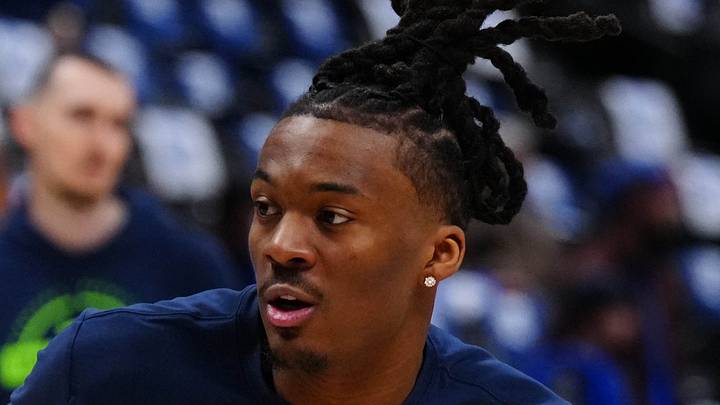
During his five-year NBA career, Bones Hyland has proven that he can score the basketball. He averaged double-digits in scoring each of his first two seasons and is averaging 9.2 points per game for his career.
He’s still young, turning 26 on September 14. Despite this, Hyland has yet to receive a notable contract in free agency thus far in his career. It feels like if he’s unable to do so after this season, that day may never come.
Bones Hyland needs to prove himself this season
For much of last season, Hyland looked like a player who was worth more than the veteran’s minimum. Yet early this offseason, the Minnesota Timberwolves brought him back for that same veteran’s minimum—a one-year deal worth $2.85 million.
That will put his career earnings at just over $16 million. Obviously, by NBA standards, Hyland hasn’t made all that much. For a player whose speed puts great pressure on opposing defenses and who has made 37 percent of his career 3-point attempts, it would seem that he should find a larger deal on the open market.
As a smaller guard—listed at 6-foot-1 and 165 pounds—Hyland is never going to be a force on the defensive end. While someone like Trae Young is a savant on offense, allowing his defensive shortcomings to be more easily tolerated, Hyland isn’t at that level.
In all honesty, though, Hyland was likely looking at a more lucrative contract, perhaps a multiyear deal, had it not been for another year of postseason struggles. It got to the point where Chris Finch felt he could no longer leave him in the rotation. Hyland had the same playoff issues during his previous stops with the Denver Nuggets and Los Angeles Clippers.
Hyland should outplay his minimum deal, especially during the regular season. Given the roster’s current construction, he should be one of the top three players off the bench, along with Joan Beringer and either Ayo Dosunmu or Terrence Shannon Jr. (one of the two may be in the starting lineup).
Greater consistency would also help. A great example of this is Hyland’s February from last season. In four games between February 4 and 9, he shot 60.5 percent from the field and averaged 15.8 points. In his next five outings that month, those numbers dipped to 25 percent and 2.8, respectively.
Hyland easily had his most efficient season scoring inside the arc in 2025–26. By becoming more consistent, giving greater effort on defense even if he’ll never be a plus defender, and avoiding another complete playoff drop-off, Hyland can finally earn a contract worth more than the minimum.
 Add us as a preferred source on Google