

Two years ago, the Minnesota Timberwolves (now somewhat infamously) traded up for Rob Dillingham. While trading a future first-round pick and a swap for Dillingham was an enormous whiff, that shouldn't permanently turn the Wolves away from this archetype of speedy yet undersized guards, particularly given their glaring need for perimeter creation.
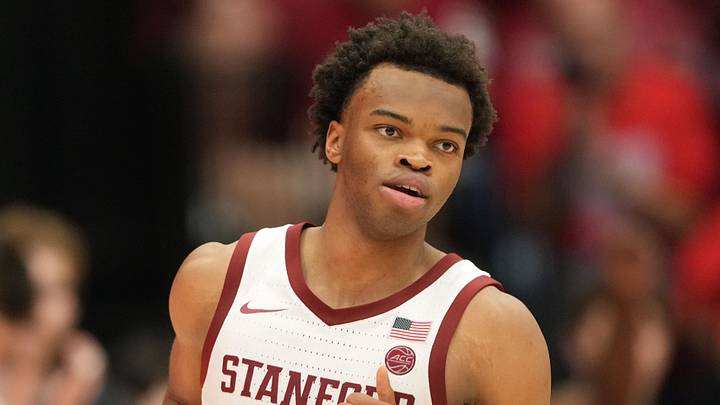
Stanford guard Ebuka Okorie could be the perfect way to help fans forget about Dillingham. The two players share some clear similarities as small guards with blazing speed and dazzling handles. Of course, drafting Okorie at pick 28 is inherently less risky than trading up for Dillingham was. Furthermore, Okorie's ability to relentlessly generate rim pressure bodes well for his NBA impact.
Drafting Ebuka can't be the Wolves' only way to address their need for perimeter creation this offseason, but he could be part of the puzzle. Okorie could be a sparkplug scorer in the same way that Bones Hyland was this past season. However, there's a chance the Wolves hit a home run and find a long-term solution to their guard problem.
The Wolves have conducted a pre-draft workout with Okorie, so it's clear he's on their radar at pick 28.
Why Ebuka Okorie is a safer bet than Rob Dillingham
Okorie might not be getting discussed as much as some of the other top-end guards. A large part of this is because he played for a so-so Stanford team. Make no mistake, though, the New Hampshire native was an extraordinarily productive offensive engine. He averaged 23.2 points and 3.6 assists. Doing this in the ACC, with little creation alongside him, is extremely impressive.
As mentioned earlier, Okorie's signature skill is undoubtedly his slashing, which frankly is a skill that nobody in this class can match. According to Databallr, Okorie recorded 13.1 rim attempts per 100 possessions, a number which ranks in the 99th percentile.
Quick doesn't cover when describing Okorie; he truly has a special level of burst. His general self-creation profile indicates genuine star upside, with 81.2 percent of his field goals being unassisted via CBB Shot Charts.
There are undeniable size concerns with drafting someone who measured in at 6-foot-1.25 (without shoes), but this level of rim pressure and self-creation counteract this risk to some extent. For reference, Dillingham recorded 8.6 rim attempts at Kentucky.
The Wolves have lacked a rim-pressuring guard alongside Anthony Edwards. Thankfully, trading for Ayo Dosunmu helped fill this void. Still, the Wolves would stand to benefit from adding another consistent source of rim pressure. Plus, doubling down on their newfound identity of pace would be highly logical.
There are some reasonable concerns about Okorie's playmaking. Notably, he posted a ho-hum 1.9 assist-to-turnover ratio. It's also worth wondering how he'd adapt to a more off-ball role at the NBA level.
His decision-making could sharpen up, but he generally has great poise with the ball in his hands. Again, Okorie won't solve close to all of the Wolves' backcourt woes, especially as a rookie. But still, he could help in aiding the Wolves' need for extra creation and could be a long-term piece alongside Ant-Man.
I want to quickly touch on Okorie's defense because, despite his frame, there are a few positives regarding his defensive projection. Most notably, he posted a 6-foot-7.75 wingspan at the combine and is fairly sturdy at 186 pounds. He is pesky at the point of attack, generating steals on and off the ball and generally has a high defensive motor.
This is perhaps the single biggest difference between him and Dillingham, who at the combine was 22 pounds lighter than Okorie and had a 6-foot-3 wingspan.
I totally get it if Timberwolves fans are scared of taking any small guard ever again after Dillingham. Nevertheless, the differences between Okorie and Dillingham are undeniable. Tim Connelly has a clear affinity for this archetype and this time it could work out in a big way.
The only question is whether Okorie will be on the board at pick 28.
 Add us as a preferred source on Google