

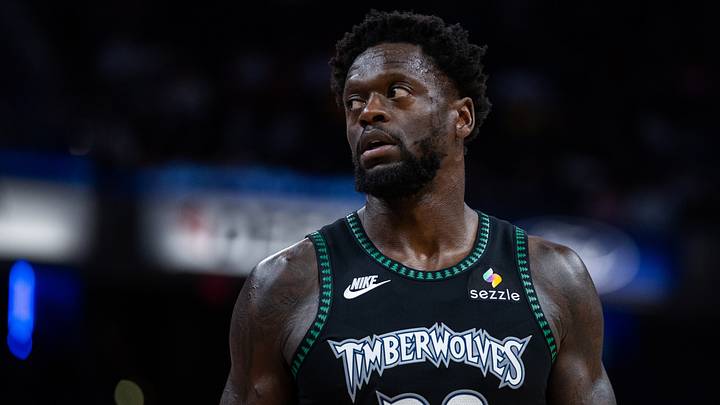
The Minnesota Timberwolves defeated the Brooklyn Nets 142-116 on Monday night, but the bigger storyline was the return of Julius Randle. Acquired in the trade that sent Karl-Anthony Towns to the New York Knicks right before the 2024-25 season, Randle spent two years in Minnesota, which included a run to the Western Conference Final and a disappointing second season.
Randle’s time in Minnesota was dragged through the mud last summer as he was traded to the Nets as part of a four-team deal that brought LaMelo Ball to the Timberwolves. Head coach Chris Finch also noted that the Wolves “traded moodiness for giddiness” in that deal, making the reaction he would get from Wolves fans uncertain.
In the end, Randle got a tribute video and a standing ovation from fans. Yet it’s also part of a complicated legacy: Randle wasn’t as bad as he seemed, but he also didn’t fill the void that Towns left behind.
Julius Randle inherited the unenviable task of replacing Minnesota Timberwolves legend Karl-Anthony Towns
Randle’s time in Minnesota was complicated from the jump. Coming off their first run to the Western Conference Finals in 20 years, Randle came to the Timberwolves as part of a three-team, seven-player trade where, most notably, Towns was traded to the Knicks.
The deal proved beneficial for the Timberwolves in the long run, as they gained salary cap flexibility, a key role player in Donte DiVincenzo, and a first-round pick from the Detroit Pistons that was used to take a future franchise staple, Joan Beringer. But it was also a punch in the gut for Timberwolves fans, as they felt that Towns was their guy.
Towns joined the Wolves as the first overall pick in the 2015 NBA Draft, representing the first time the franchise won the draft lottery. While there were some dark years at the beginning of his career, Towns was one of the players who dragged them out of it, helping them earn their first playoff appearance in 14 years during the 2017-18 season.
It wasn’t perfect, as Towns had a tendency to short-circuit in moments and even drew the ire of teammate Jimmy Butler. But he had the same pull as a captain does in hockey, staying through the tough times and finally reaping the benefits when the Wolves made the Western Conference Finals in 2024.
With a strong presence in the community, Towns felt like one of their own, and many Wolves fans celebrated when he won an NBA title with the Knicks last summer. That gave Randle big shoes to fill and an unenviable position when he came to Minnesota.
Randle’s two years with the Timberwolves were complicated but valuable
Statistically, Randle was a solid replacement for the Timberwolves. Over two seasons, he averaged 20.0 points, 6.9 rebounds, and 4.9 assists per game while shooting 48.2 percent from the floor and 32.9 percent from 3-point range.
Randle was also a key reason why the Wolves got to the Western Conference Finals for the second straight year, sacrificing his own stats to defer to Anthony Edwards as the team’s top offensive weapon.
While he was a “co-star,” he still made an impact, averaging 21.7 points, 5.9 rebounds and 4.9 assists per game during Minnesota’s 15-game playoff run at the end of the 2024-25 season and helped Minnesota with big performances during series against the Los Angeles Lakers and Golden State Warriors.
“It was his selflessness at the time in the middle of that first season that really kind of ignited our run,” Timberwolves head coach Chris Finch said via Locked On Wolves podcast host Jack Borman. “The first two rounds of the playoffs that year, he was probably one of the top five players in the league.”
Finch has never been shy about waxxing poetic about Randle, but he has a point: the Wolves don’t make a deep run without Randle. Unfortunately, there was another side of the coin.
Randle’s second season in Minnesota had more lows than highs. The chemistry in the locker room had changed and while The Athletic’s Jon Krawczynski noted that several players were at the cause of the “moodiness” that has been highlighted over the summer, Randle may have been part of that after being placed in a potential package for Giannis Antetokounmpo at the trade deadline.
“No one hated Julius in that locker room because…you can’t hate him. [He’s] a super nice guy. He’s a great dad. You can tell he cares about teammates and he’s a good dude. So he’s not a jerk by any means,” Krawczynski said on Monday’s episode of The Jon Krawczynski Show.
“There’s no question that he was part of the temperamental issues that the team experienced last year in particular. He wears his emotions on his sleeve, and so when he is frustrated, when he is feeling down, when he is not in rhythm, you see it just dripping off his body like sweat. And that can be hard for teammates and coaches to kind of just deal with the ups and downs of it within a season.”
Krawczynski added that Randle “was far from the only one” who was responsible for the Timberwolves’ moodiness last season. But fans would argue he was labeled the poster child for that problem, dribbling into oblivion in the post and, at times, looking like he would rather be anywhere else than on the court.
The swings continued as the Wolves headed into the playoffs. With DiVincenzo and Edwards out with injuries, Randle helped the Wolves get past the Denver Nuggets in the first round, averaging 19.2 points, 7.3 rebounds and 4.2 assists per game. But he disappeared during the second-round series against the San Antonio Spurs, averaging 12.8 points, 7.7 rebounds and 1.5 assists per game while shooting 34.2 percent from the floor and 19.0 percent from 3-point range.
Randle deserved the standing ovation he received from Timberwolves fans
By the end of the Spurs series, fans were eager to send Randle away, which encapsulated what Randle’s time in Minnesota was like. It’s also clear the Wolves came out ahead in the aftermath, as Ball has changed the style of play and culture in his first year with Minnesota.
This makes the response Randle received on Monday night seem appropriate. It wasn’t the same emotion that Wolves fans had when Towns returned as a member of the Knicks. It also likely won't reach the same level that fans will have when Naz Reid returns to Minneapolis as a member of the Charlotte Hornets later this year.
But Randle also didn’t deserve a level of angst that Butler got after soaking the bridge in gasoline and shooting it with a rocket launcher on his way out of town in 2018. Or how Stephon Marbury grew jealous of Kevin Garnett’s contract with the Wolves and forced his way out in 1999.
Booing Randle would have felt like a step too far, as he provided plenty of good moments with enough bad ones to know that things had run their course. It’s a complicated legacy that won’t make him a household name with Wolves fans down the road, but it was enough for fans to pay him their respects and wish him the best moving forward.
 Add us as a preferred source on Google