

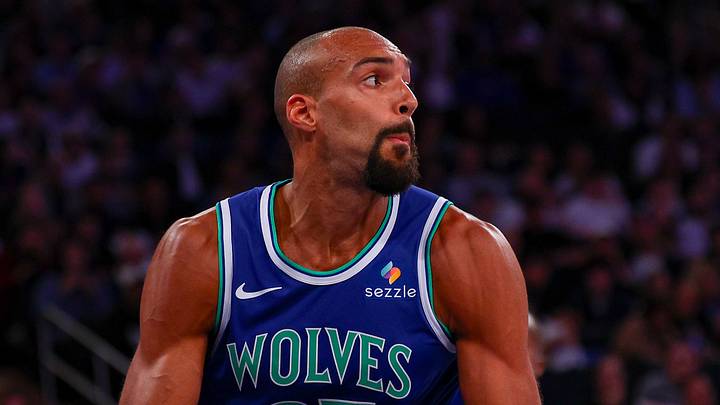
It's been a major talking point that the Minnesota Timberwolves abandoned their frontcourt identity by making the LaMelo Ball trade. There's a lot of truth to this. They traded both Julius Randle and Naz Reid for a perimeter-centric player in Ball. And the Wolves no longer have much frontcourt depth.
The late offseason signing of Jonathan Kuminga should ease a lot of the concerns that come with this identity shift, though.
Health permitting, I don't believe that the Timberwolves' frontcourt defense will take a step back. In fact, I believe that the frontcourt trio of Kuminga, Rudy Gobert, and Joan Beringer is better than the Randle-Gobert-Reid trio.
Sure, the Wolves won't always be able to operate with two physical big men as they did in past years. When Kuminga is off the floor, the Wolves will have to lean into some unconventional power forward looks. I'd expect to see a lot of Jaden McDaniels in a roamer role, which is tantalizing given his defensive playmaking chops.
They might not have a ton of physicality, but always having some rim protection is a major advantage, and Kuminga is a better defender than many people believe. In short, this is why I believe in the Timberwolves' revamped frontcourt.
The Timberwolves' frontcourt defense is better than you may think
Firstly, I want to note that Gobert is a walking top-10 defense and an elite anchor. As such, there should be no major concerns about Minnesota's defense.
While both Reid and Randle are physical, neither player is a positive defender. Randle has his moments of on-ball brilliance where he can disrupt opposing players with his brute strength, but he's an aloof off-ball defender. He would often get backcut, struggle to rotate, and barely force turnovers. Embarrassingly, Randle ranked in the 8th percentile for blocks per 100 possessions per Databallr.
You could never question Reid's effort, and part of his problems came down to him being forced into a rim-protection role. He was much more active as a defensive playmaker than Randle, but he struggled to defend both high-level forwards and big men. Plus, he isn't very switchable and could get burned against quicker players.
The advantages of Kuminga and Beringer essentially replacing Randle and Reid are clear.
Kuminga offers similar physicality to Randle. Thus, he can guard quality forwards. Ranking in the 85th percentile for matchup difficulty per Basketball Index last season, Kuminga proved that. And while he's not perfect off the ball, he forces more turnovers than Randle. Kuminga is also extremely agile and holds up better on guards than Randle. Notably, he ranked in the 86th percentile for perimeter isolation defense.
Beringer might be more important to the Timberwolves' defensive success. Yes, there's some risk in entrusting a raw 19-year-old with a crucial bench role. However, unlike Reid and Randle, Beringer is a natural rim protector.
Will he struggle with fouls, physicality, and defensive positioning at times this season? Surely, but having a natural rim protector when Gobert is off the floor is a clear advantage. In limited NBA minutes, Beringer has proven to be a quality shot-blocker due to his freaky athleticism.
The Wolves' defense collapsed with Gobert off the floor last season. According to Cleaning the Glass, the Wolves' defense was 11.8 points per 100 possessions better with Gobert on the court, a number that ranked in the 98th percentile. Beringer will have some growing pains, but from a roster construction standpoint, it will make a heck of a lot more sense to have a rim protector backing up Gobert.
Again, there are legitimate concerns about the Wolves' frontcourt depth and physicality. Regardless, their frontcourt trio is a more logical pairing than what they had in the past two seasons.
 Add us as a preferred source on Google