

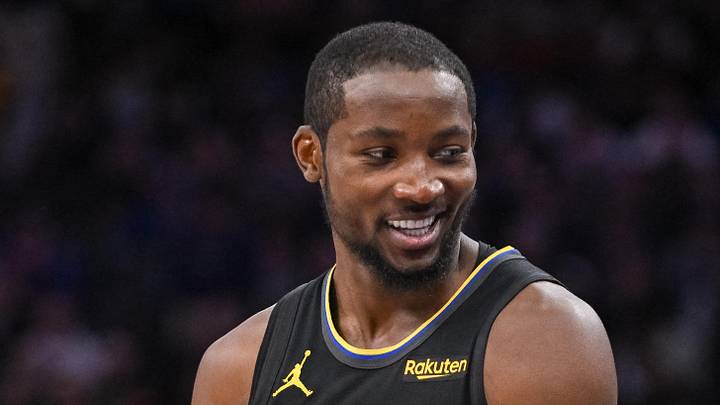
For much of his career, Jonathan Kuminga has been known as an ultra-talented yet frustrating and somewhat selfish player. In need of a power forward, the Minnesota Timberwolves decided to gamble on his talent, signing him to a two-year deal (with a player option after one year).
It’s a 2-year, $12M deal for the Wolves and Jonathan Kuminga, a source tells @TheAthletic
— Jon Krawczynski (@JonKrawczynski) August 26, 2026
Some of these concerns are warranted, as Kuminga's poor shot selection and ball-dominance, paired with a lack of outside shooting, can be problematic. Likewise, he needs to prove that he's open to a scaled-down role, something he wasn't open to with the Golden State Warriors. And yes, it's telling that he's on his third team despite not turning 24 until October.
Regardless, people can change. Thankfully, the Timberwolves have the perfect roster to maximize Kuminga's skill set and help him fulfill his destiny as a high-end role player. If he can do so on a successful (perhaps even title-winning) Timberwolves team, then people will forget about the current narratives around his game.
The Timberwolves are the ideal place for Kuminga to transform his game
Two teams giving up on Kuminga and nobody being willing to offer him a long-term lucrative contract should be a wake-up call for him. He needs to realize he's not a future star and that his best chance to earn a big-time contract is by buying into a complementary role.
Yes, the Warriors tried to hammer that point home. Sometimes personalities don't mesh, though. Steve Kerr might not have been able to get this message across, but Chris Finch could connect with him more.
Another factor is that Kerr's detailed system wasn't an ideal fit for Kuminga. Finch's free-flowing system that now heavily prioritizes pace should prove to be a better fit. Additionally, the Warriors always needed extra creation, while the Wolves simply need an athletic play-finisher. LaMelo Ball's playmaking should unlock more of Kuminga's play-finishing skill set.
These factors collectively could result in more buy-in from Kuminga than at his past stops.
Kuminga's defensive fit with the Timberwolves is also clear. He is playing alongside an elite rim protector in Rudy Gobert and an elite point-of-attack defender in Jaden McDaniels. Having this extra layer of insulation should help Kuminga thrive and maximize his athletic gifts.
His primary defensive role will be to guard opposing forwards and attack the glass. While Kuminga hasn't been perfect on defense throughout his career, these are skills that he can provide. Last season, he ranked in the 85th percentile for matchup difficulty per B-Ball Index and averaged 5.3 rebounds per game.
Without a doubt, Kuminga can be a high-quality stopper against physical forwards and grab boards at a high rate. Perhaps the Timberwolves' defensive culture can also help him become a more engaged off-ball defender, which has been the main knock on his defense.
The bigger picture is that Kuminga has a golden chance to prove that he can impact winning basketball on both ends of the floor. Aaron Gordon was never as polarizing as Kuminga, but with the Denver Nuggets, he became a high-end complementary forward and thus boosted his public perception. Kuminga could have a similar arc.
If everything goes right, Kuminga can play a similar role to Gordon and become an integral part of a championship-winning team. That would significantly change how he's viewed and set him up for the massive long-term contract he wants.
 Add us as a preferred source on Google