

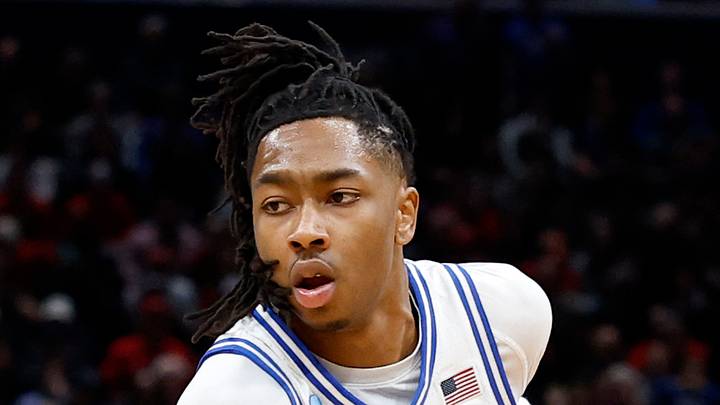
Minnesota Timberwolves rookie Isaiah Evans has plenty of upside to be a long-term contributor. Despite being drafted with the 33rd pick, Evans was a first-round talent. However, it's hard to see where he fits into the rotation, and frankly, it's doubtful that he'll play much.
As a rookie, Joan Beringer learned the hard way that despite having immense upside and the Timberwolves' internal belief in him, there simply weren't minutes available for him. From this standpoint, there are clear similarities between Evans and Beringer.
The Timberwolves' rotation will be hard for Isaiah Evans to crack
Last season, the Timberwolves had a loaded frontcourt rotation with Rudy Gobert, Julius Randle, and Naz Reid, which limited Beringer to occasional situational minutes. Notably, Beringer played in 314 minutes across 40 games.
I'd expect a similar number of minutes from Evans as a rookie, and he'll likely spend some time in Iowa just like Beringer did. After trading Randle and Reid, the Timberwolves have open frontcourt minutes.
The flipside is that their guard/wing rotation is pretty loaded, making things tricky for Evans.
With LaMelo Ball, Anthony Edwards, Ayo Dosunmu, Jaden McDaniels, Terrence Shannon Jr., Jaylen Clark, Bones Hyland, Cody Williams, and Donte DiVincenzo (if he returns), it's fair to say that Evans is a depth and developmental piece. The spots of Clark, Hyland, and Williams aren't 100 percent secure. Frankly, Williams is likely out of the rotation.
Still, even if he can leapfrog two of these players, Evans would be the ninth man in the rotation.
Evans can still be a quality player long-term
Evans was one of the best 3-point shooters in the 2026 Draft. He shot 38 percent from deep range on 5.8 attempts per game in two seasons at Duke. Whether it's purely spotting up or coming off screens, Evans is a lights-out shooter. This shooting ability gives Evans a clear, bankable NBA skill.
And yes, I know he couldn't buy a bucket in summer league, but the two-year college sample size should outweigh this. Evans also showed more overall shot creation and general scoring chops in his sophomore season with the Blue Devils. As such, he has the potential to be a productive microwave scorer, not just a 3-point specialist.
Outside of scoring, Evans needs to find other ways to impact the game. His playmaking needs to improve. Plus, while Evans fights hard on defense, he could stand to benefit from adding some muscle.
Regardless, Evans has the upside to be a high-end role player and has a skill set that will allow him to complement Anthony Edwards. Even if he doesn't play a ton as a rookie, this outcome is in the cards.
Does Chris Finch hate playing rookies?
The elephant in the room is that head coach Chris Finch doesn't like to play rookies. Some people have pointed to this as the primary reason why Evans won't play, especially since his shooting gives him some plug-and-play upside. Outside of Beringer, Rob Dillingham and Terrence Shannon Jr. didn't earn minutes during their rookie season.
I'll defend Finchy on this one. Here's the reality: Minnesota is trying to win a title and can't afford to force-feed a rookie minutes.
Could he have played Beringer a bit more? Sure, but the loaded frontcourt rotation didn't make things easy, and Beringer was pretty raw. Dillingham was far too raw despite Minnesota needing some extra guard play. Finding minutes for Shannon was hard with an established top-eight, including two wings off the bench.
When you break it down like that, Finch's handling of rookies is pretty logical. If and when Evans doesn't crack the rotation, fans shouldn't get out their pitchforks—there's simply too much established talent above him.
Overall, while Evans is unlikely to see the court much, he still can be a quality long-term piece, and it doesn't mean that Finch hates playing rookies.
 Add us as a preferred source on Google