

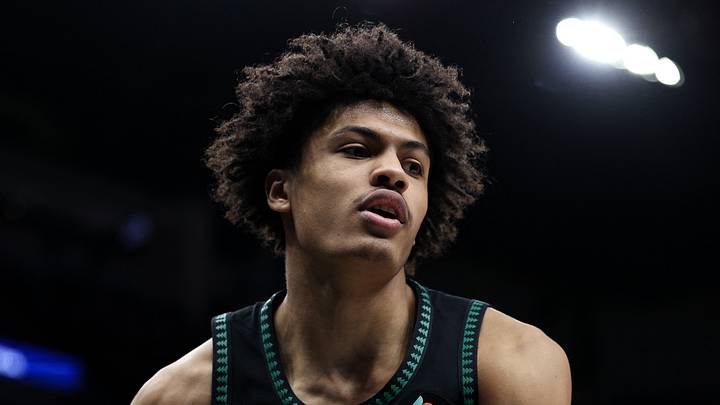
There's understandably a ton of excitement around Minnesota Timberwolves second-year big man Joan Beringer. He flashed his upside in limited minutes last season and is a freaky athlete. Between his rim-running, shot-blocking, and mobility, Beringer is a tantalizing player.
While he's somewhat raw, I think it's easy to believe in him being a quality regular-season backup to Rudy Gobert. Playing roughly 15 minutes a game is a sizable but not overly taxing role. My bigger question is: Will he be ready to contribute in the playoffs?
A strong regular season doesn't ensure playoff success for Joan Beringer
Even if he improves his flaws in the regular season, it's not guaranteed that this will carry into the postseason. Time and again, we've seen players perform well in the regular season, showing off a ton of growth, before dropping to their old level of play in the playoffs.
Look at the newly minted $200 million man, Jalen Duren. He was an All-NBA player in the regular season before turning into a pumpkin in the playoffs. Boston Celtics' big man Neemias Queta shares some parallels with Beringer. Both players are athletic rim runners who have struggled with foul trouble. Queta seemingly fixed these problems during last year's regular season, before regressing to old habits in the playoffs, averaging 4.1 fouls. He was borderline unplayable in the Celtics' first-round series loss to the Philadelphia 76ers due to his lack of discipline.
I'm not saying that fans shouldn't be excited if and when Beringer excels in the regular season. Rather, my point is that the ultimate proof of how ready Beringer is will come in the playoffs, not the regular season.
The Timberwolves have championship aspirations. Yet one of their seven most important players is an unproven 19-year-old. Okay, fine, he'll be 20 in November—does that make you feel better?
Again, I have a ton of hope for Beringer this season and long-term. But there's no denying that there's some risk with him being so important to the rotation, especially in high-leverage moments. With how Minnesota's roster is built, it'll be a tough pill to swallow if Beringer struggles in the playoffs.
Maybe they make a move at the deadline, but for now, he and Trey Lyles are the only bigs off the bench. It's crucial to note that Lyles is best served as a power forward and doesn't provide much rim protection. As such, if Beringer struggles in the playoffs, the non-Gobert minutes could be disastrous. Even if it's only around 12 to 15 minutes, this could crush the Wolves' chances in a series. The margins matter in the playoffs so much.
Possible playoff concerns for Beringer
Beyond this and his general inexperience, there are a few early red flags to mention about Beringer's playoff viability. I hinted at this earlier when talking about Queta, but hs foul woes are a concern. Beringer averaged an absurd 5.4 fouls per 100 possessions, and he ranked in the third percentile for foul percentage per Cleaning the Glass.
I believe that Beringer can clean this up in the regular season, and in a 15-minute-per-game role, this shouldn't be a major issue.
However, in the playoffs, when game-planning becomes more prevalent and offenses attack players more often, can he defend without fouling? That remains unclear, and as established with Queta, some players of a similar mold can regress due to the nature of the playoffs.
The other concern about Beringer is his ability to deal with bigger physical centers. While he's put on some weight, it remains to be seen how he can deal with these types of bruisers, especially given his foul trouble.
The Wolves will likely play one of the Denver Nuggets, Houston Rockets, or Los Angeles Lakers in the first-round. With these teams Nikola Jokic, Alperen Sengun, Steven Adams, and Walker Kessler, Beringer could be forced to guard a high-end center at some point. Sure, the Wolves could stagger minutes, but that's easier said than done, and there could be some minutes strategy to force a matchup with Beringer. Furthermore, in the case of the Rockets, they have two quality centers.
Beringer will also have to prove that he's physical enough to clean up the defensive glass. He has a strong motor, but only ranked in the 10th percentile for defensive rebounding percentage per Cleaning the Glass last season.
Perhaps Beringer is so good that none of this matters. Given his athleticism, rim-running, and shot-blocking, that's a distinct possibility. Still, it's a big ask for a second-year player who didn't play much as a rookie to have a key bench role on a team with title hopes, especially since Beringer started playing basketball in 2021. And for the Timberwolves, Beringer being a quality backup big man in the regular season alone won't be enough; they'll need him to produce at a high level in the playoffs.
 Add us as a preferred source on Google