

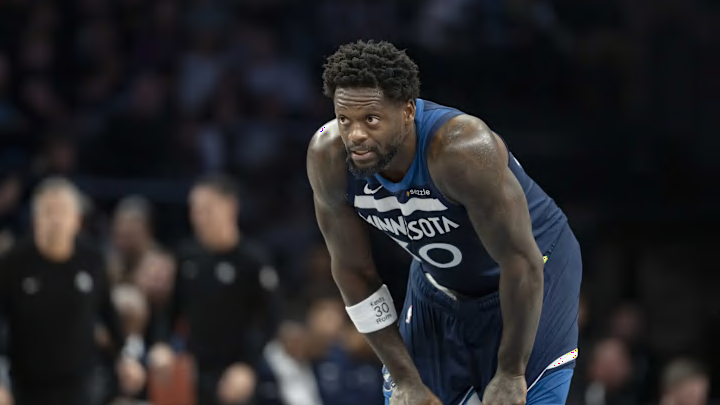
The Minnesota Timberwolves are in the midst of a middling 6-5 month of March. They started the month by racking up three wins, meaning they are just 3-5 since. The Wolves are currently sixth in the Western Conference, behind the Denver Nuggets (both have 43-28 records) via tiebreaker, and just a half-game behind the fourth-seeded Houston Rockets.
Having home court advantage at least in the opening round of the playoffs is still very much in play. The Timberwolves likely will have to buck two trends from March in order to have a shot to move up to fourth. All month, they have been losing both the offensive rebounding and turnover battles.
Beyond this building, these good habits will be vital for postseason success.
Giving up way too many offensive rebounds
Allowing the opposing team second (and sometimes third) opportunities has become a major issue for Minnesota in March. It has become so much of a problem that Chris Finch was asked about it after Friday’s loss to the Portland Trail Blazers. Finch surprisingly singled out Julius Randle, something he’s never done before, by saying,
"We knew our guards needed to rebound. Ayo did a good job on the defensive glass, Rudy did a good job, but after that...Julius has 3 defensive rebounds. That's not good enough."
Randle needs to provide more effort in securing defensive rebounds, but it’s the whole team as well. In their 11 outings in March, Minnesota has given up 144 offensive rebounds, while only having 109 of their own.
Remarkably, 9 of their 11 March contests have seen the Timberwolves secure less offensive rebounds than the opposition. In 1 game, they equaled their opponent's output, meaning they only have 1 game this month where they have outrebounded the opponent on the offensive glass.
Heading into March, Minnesota held a slim 682-677 advantage over their opponents in total offensive rebounds through 60 games.
Turning the ball over too frequently
Turnovers have also been an issue for Minnesota this month. The Timberwolves are averaging 16.3 per outing in March. That includes a 25-turnover performance against the Oklahoma City Thunder, just 1 shy of a season-high. They are only forcing their opponent into 13.5 per game.
In their first 60 games, Minnesota averaged 14.7 turnovers while their opponents coughed it up 15.2 times per contest. Those numbers have changed considerably in March.
Giving up more field goal attempts
The combination of those two things has allowed the opposition to get up a lot more field goal attempts than the Timberwolves have. While Minnesota is shooting better from the field and 3-point distance, the opposition is getting up 6.6 shots more per game than the Timberwolves are in March.
With 11 regular season games remaining, it would behoove the Wolves to find a way not to be at such an offensive rebounding and turnover deficit. If these problems continue, another deep playoff run likely won't be in the cards.
 Add us as a preferred source on Google