

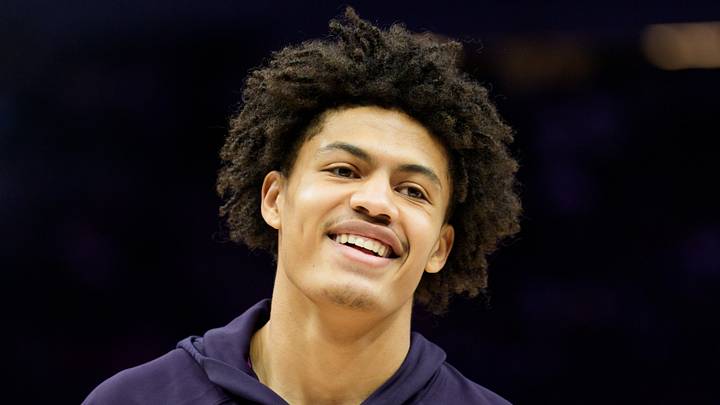
Trading Julius Randle and Naz Reid this offseason took away a lot of size from the Minnesota Timberwolves. Recently adding Jonathan Kuminga helped, but he is not as tall and weighs less than either of the departed frontcourt players.
It would seem that the Timberwolves, while being a better team in specific facets, will be a worse rebounding team than last season. There’s a fairly good chance that won’t be the case, though.
Why the Wolves could become a better rebounding team sans Randle and Reid
By nearly every measure, the Wolves were a middle-of-the-pack rebounding team in 2025–26. Out of 30 teams, they finished tied for 12th in rebounds per game (44.1) and 12th in rebound percentage (50.1 percent). During the regular season, Minnesota outrebounded its opponents by 28.
With the Golden State Warriors and Atlanta Hawks in 2025–26, Kuminga had the best rebounding season of his career. Somewhat surprisingly, the soon-to-be 24-year-old averaged more boards per 36 minutes than both Randle and Reid.
That’s not necessarily to say that Kuminga is a better rebounder than either of them, although he should help the Timberwolves in that area. It's something he should really focus on because he needs to show the Wolves, as well as the rest of the league, that he can do more than just score.
That is necessary if he wants to get more of a long-term deal, as he can potentially become a free agent again next offseason.
Randle didn’t always seem to give full effort on the glass, but his numbers were certainly affected by playing with an elite rebounder, Rudy Gobert. The same thing happened with Karl-Anthony Towns when he was paired with Gobert, and his rebounding numbers perked right back up after Towns was traded to the New York Knicks.
The Timberwolves now have LaMelo Ball, their best rebounding guard in quite some time. Standing at 6-foot-7, Ball has accumulated 11 triple-doubles and 31 double-figure rebounding totals in his 303 career games.
When Gobert isn’t on the floor this season, the team will be utilizing a lot more of the nearly 7-foot Joan Beringer. He didn’t play much as a rookie, but the soon-to-be 20-year-old did average 10.6 boards per 36 minutes. In 11 G League outings with the Iowa Wolves, Beringer grabbed 10.7 rebounds per contest, with nearly half of them coming on the offensive end. Always having a natural rim protector and glass cleaner is a key reason why the Wolves could improve in the rebounding department.
Someone like Trey Lyles is also 6-foot-9 and has been an okay rebounder for his size. A team with Gobert will never fall near the bottom of the league in rebounding prowess. It’s not a sure thing, but don’t be surprised if the Timberwolves actually hit the glass better this year than last.
 Add us as a preferred source on Google