

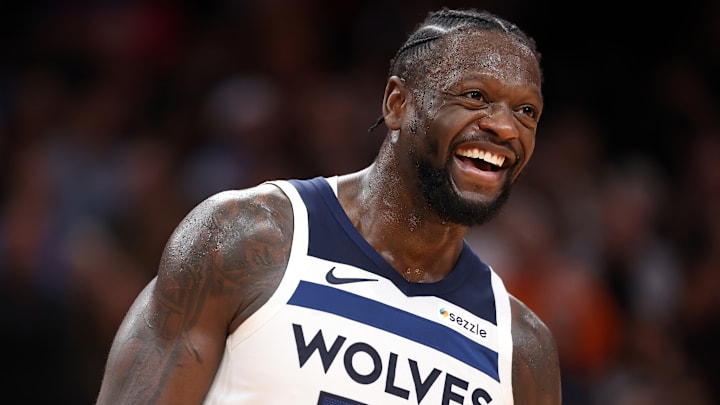
The Minnesota Timberwolves' Karl-Anthony Towns trade with the New York Knicks sent shock waves through the NBA world last September. Of course, the Wolves got back Julius Randle, Donte DiVincenzo, and a first-round pick back (which later became Joan Beringer). At the time, this trade was highly controversial as Towns had been such an important part of the Timberwolves franchise and was widely viewed as a better player.
The general consensus at the time was that the Knicks won the deal and that the Timberwolves took a step back after making their first conference finals since 2004. After both teams made the conference finals, negative talk about this trade largely cooled down.
Now it's hard to argue that this trade is anything less than a win-win. In fact, I'd argue the Timberwolves have the slight edge. Not only has Randle arguably looked better than Towns this season, but DiVincenzo has given the Wolves a much-needed scoring punch, and they were able to re-sign Naz Reid with the cap space they freed up.
The Julius Randle trade is starting to look like a masterstroke for the Wolves
Randle is averaging 22.9 points, 7.1 rebounds, and 6.0 assists this season on 49.9/35.6/83 shooting splits. Towns has posted similar averages of 22.1 points, 12 rebounds, and 3.3 assists on 46.4/35.5/88.1 shooting splits. Yes, raw counting stats don't tell close to the full story of a player or his value. However, the bigger picture to me is that even if you think Towns is a better player, it's hard to argue that he's a better fit next to Anthony Edwards.
Undoubtedly, Randle's shot creation and playmaking make him a cleaner fit with Edwards. Randle leads the team in assists and has been crucial in the Wolves' maintaining success without a traditional point guard. Of course, the Wolves' point guard play is still a problem, but where in the world would they be without Randle's playmaking? Sure, KAT can provide some level of playmaking, but he's not close to the versatile point forward that Randle is.
The other key aspect of Randle's game that makes him a better fit than Towns is self-creation. Notably, 48.6 percent of Randle's made field goals are unassisted compared to 35.5 percent of Towns' baskets. In the year before the trade, 26.5 percent of Towns' field goals were unassisted, while 49.1 percent of Randle's were.
Furthermore, Randle ranks in the 81st percentile for isolation efficiency and 10th in iso points per game. Conversely, Towns ranks in the 32nd percentile for this stat. Having a high-level shot creator makes life much easier for Edwards.
The Randle-KAT trade gave the Wolves some much needed extra creation/playmaking next to Ant
— Eamon Cassels (@EamonCassels) December 10, 2025
So far this season:
Randle 81st percentile in isolation
Towns 32nd
Randle 6 assists per game
Towns 3.3 apg
48.6% of Randle’s made field goals are unassisted
35.5% of KAT’s are pic.twitter.com/NDT4BLQznA
Perhaps the biggest concern with the Randle-Towns trade was how the Wolves would replicate KAT's shooting. However, Randle is making just .1 fewer 3-pointers per game than Towns this season. This doesn't even account for DiVincenzo's elite shooting. The Big Ragu ranks in the top 20 for both made and attempted 3s. Not only have the Wolves been able to maintain their shooting without Towns, but they've reached new heights.
My final point will be the contract difference. Randle makes $22 million less annually than Towns. It's hard to argue that Towns is that much better than Randle. This extra financial flexibility allowed the Wolves to re-sign Naz Reid in the offseason.
Overall, it's hard to argue that this trade was anything less than a great one for the Timberwolves and Tim Connelly deserves a ton of credit for this bold move.
 Add us as a preferred source on Google