

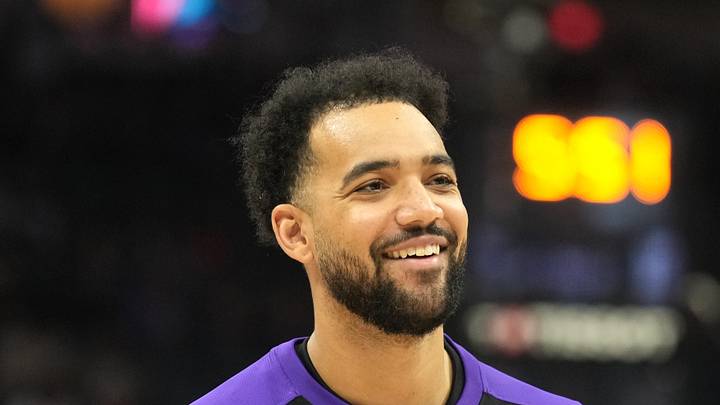
Trey Lyles is one of the more overlooked additions to the Minnesota Timberwolves this offseason. Of course, most of the attention has gone to LaMelo Ball and, more recently, Jonathan Kuminga. Both of those newcomers will be in Minnesota's starting lineup, unlike Lyles.
Britt Robson of the MinnPost brought up Lyles with head coach Chris Finch during a sit-down interview.
“Uh…I don’t see a 22-minute-a-night role,” Finch said. “Too early to say. But one thing I do like about Trey, he is the skilled big category not just because of his ability to make a three. What I really like is his attacking on close-outs. He can make good decisions out there."
Those are qualities that the other bigs on Minnesota’s roster don’t necessarily possess.
Trey Lyles is different from Minnesota’s other bigs on the roster
Lyles joins the Wolves after spending 10 seasons in the NBA and last year overseas in Spain.
While he is naturally a power forward, he can play center, particularly in games when either Rudy Gobert or Joan Beringer is unable to play.
During his NBA career, Lyles has attempted just shy of three 3-pointers per game and knocked them down at a 34.7 percent clip. While that’s not spectacular, he’s also not someone whom defenses can ignore from beyond the arc.
Gobert certainly isn’t going to provide that. The next 3-pointer that Gobert makes will also be the first made 3-pointer of his career. Beringer didn’t even attempt a 3-pointer as a rookie, whether with the NBA club or while playing in the G League with the Iowa Wolves.
The Timberwolves are used to rostering stretch fives, whether it’s Karl-Anthony Towns or Naz Reid. Julius Randle wasn’t the most accurate, but he wasn’t afraid to attempt them, either. Lyles fits the bill and could give the Wolves some five-out lineup looks.
Kuminga, who will start at power forward, is shooting just 33.2 percent from deep in his career. He also isn’t as tall as the others mentioned, standing 6-foot-7, and he attempts 3-pointers less frequently than those players as well.
For Lyles to find a consistent role in the rotation, he needs to make his outside shots. During his NBA career, he has shot at least 38.1 percent from 3-point range in four different seasons, but he has also shot no better than 32.1 percent in three seasons.
Finch also mentioned attacking closeouts. Obviously, since Gobert and Beringer aren’t threats from outside, they don’t get to display that skill.
It’s still unclear whether Lyles can find a regular role on a Timberwolves team that has a bunch of players who could play ahead of him. He does have qualities that no other big on their roster has, though, and he will get his moments at different points in the season.
 Add us as a preferred source on Google