

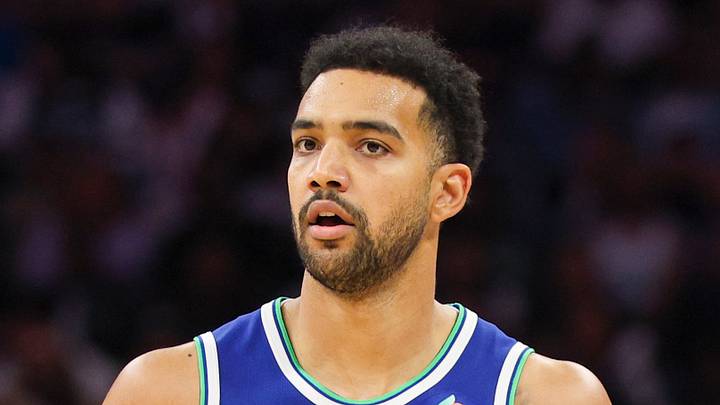
Not much was made of the Minnesota Timberwolves signing Trey Lyles this offseason. Lyles' counting stats of 6.4 points, 4.3 rebounds, and 0.9 assists certainly aren't eye-popping.
Make no mistake, though: Lyles has been super impactful in his role. He has made a strong, well-rounded impact as a veteran big man on a team that clearly lacks frontcourt depth. So let's give Lyles his flowers and explore how he's been a positive contributor to the Timberwolves' early-season success.
Trey Lyles is proving to be an impact player
Lyles' basketball IQ has been key to his impact on both ends of the floor. Simply put, he doesn't make bad plays. On offense, he plays off the Wolves' on-ball guys nicely, providing some floor-spacing juice and off-ball connectivity with his screening.
Statistically, Lyles is only shooting 32 percent from beyond the arc. However, two recent bad games dropped this number down from 37 percent. More importantly, perhaps, Lyles is a respected shooter. Defenses don't want to leave him open, and his presence, in turn, opens up opportunities for the rest of the team.
On a similar note, Lyles gives the Timberwolves a wrinkle of five-out spacing, which is something that Finch has utilized at times. Now, he most often operates alongside Rudy Gobert or Joan Beringer. Either way, he gives their frontcourt some extra variety due to his spacing.
As hinted at earlier, Lyles also doesn't take bad shots, he makes solid reads as a connective playmaker, and he's always in the right spot.
Another thing I appreciate about Lyles' game is that his offensive skill set is low-usage. Every team needs a player who can play off stars and doesn't need heavy on-ball reps to succeed. That type of stuff doesn't show up in the stat sheet, but it benefits the team, and it's exactly what Lyles provides.
Lyles isn't an all-world defender or anything. He's not a natural rim protector, nor is he a dynamic athlete. Regardless, Lyles has provided a big boost to the Wolves on the glass. In fact, his 4.3 rebounds per game is where the stats reflect his impact. He uses his IQ and size to position himself for rebounds and is a big reason why the Wolves have surprisingly led the league in rebounding so far.
And despite not being an elite athlete, Lyles is pretty switchable on the perimeter. This is another benefit of running those small-ball lineups with Lyles at the five in spurts. On the ball, Lyles is pretty sturdy for a backup four. You don't want him guarding stars, but his positioning and strength allow him to hold his own against physical forwards.
The Wolves' frontcourt depth has exceeded expectations this season, and Lyles has been a big reason why. His game isn't flashy, and his numbers aren't eye-popping, but his impact has been clear to anyone who has watched the Timberwolves closely, and every team needs a role player like Lyles. For a veteran's minimum contract, Minnesota clearly struck gold by signing Lyles.
 Add us as a preferred source on Google