

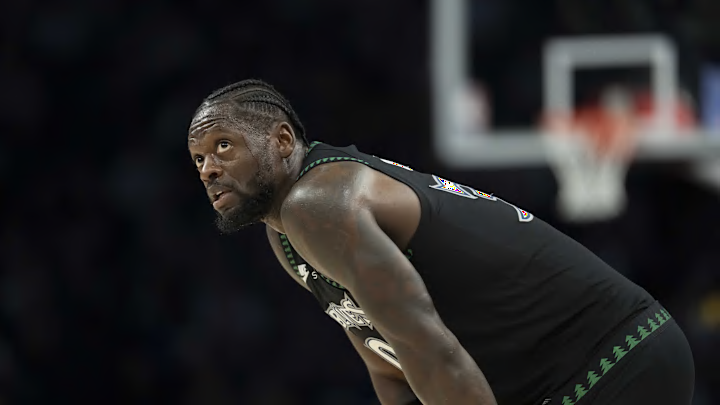
Through the first month or so of the season, Julius Randle was playing like an All-Star. He was scoring efficiently across all three levels, working as a playmaking hub and getting guys open looks, and he even looked more engaged on the defensive end. Things were looking like the Randle the Minnesota Timberwolves got in the first two rounds of the playoffs last year, was here to stay.
But fast-forward to now, and the production has fallen off a cliff. Defensively, he's nowhere to be found; his three-point shot has regressed way below the mean, and his overall vibes have been way off since the new year.
As the Wolves are in the midst of a three-game losing streak and fighting for a top-four seed, the timing of Randle's slump is awful.
I wish I could say this is an unfortunate trend and that it will correct itself soon. However, unfortunately, this has been the story of Julius Randle's entire career: inconsistency and volatility.
Randle's impact has been limited recently
Since the turn of the calendar year, Randle is shooting 27.7 percent from 3-point range. He's never been a sharp shooter by any means, but at the beginning of the season, he was taking and making threes with confidence. Now, he's made the already prevalent spacing issues of the team even worse by failing to effectively space the floor.
Furthermore, in the past 10 games, Randle is averaging just 14.1 points. Thus, he is not providing the second option level production the Wolves need next to Edwards.
If he isn't going to score well, the Wolves will have to live with that, and his playmaking becomes all the more important. In March, he's averaging 3.7 assists to go along with 3.3 turnovers per game.
With the Wolves not starting a conventional point guard, and Anthony Edwards being a score-first player, Randle must shine in the role of lead facilitator, which we've seen him excel at in spurts here before. But averaging nearly the same amount of turnovers as assists is a major issue that the Wolves don't have the personnel to cover up.
The questions about the ceiling of a Julius Randle team are growing by the day
I've always been a skeptic of what the ceiling is for a team that has Julius Randle as a mainstay. Last playoffs, I was about ready to eat my words as Randle led the Wolves to a dominant first two rounds. But against Oklahoma City, a very physical team, Randle looked borderline unplayable.
The thing with Randle is that he tries to fight physicality with physicality, thinking he can just out-muscle anyone in front of him, and that style is a death wish in the playoffs. The talent has never been the issue with Randle, but it feels as though he doesn't know what type of player he wants to be, hence the constant body language issues.
If I'm Tim Connelly, this summer, I'm looking to trade Randle for a point guard. This roster is in dire need of a shakeup, and the fit with Randle has always been up and down.
This would carve a path for Naz Reid to finally be a starter, which I believe he's earned. It would also open up more shots for Jaden McDaniels and take some of the ball-handling pressure off of Anthony Edwards.
 Add us as a preferred source on Google