

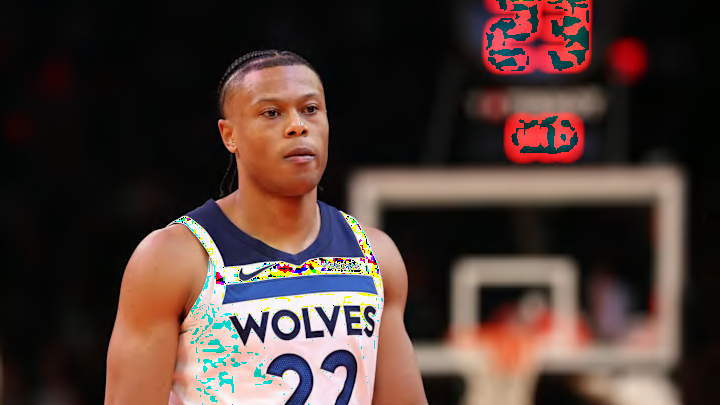
Jaylen Clark has provided the Minnesota Timberwolves with some quality minutes on the defensive end of the floor this season. Clark has stood out among the young trio of him, Terrence Shannon Jr., and Rob Dillingham. Despite his immense defensive value (which I don't want to understate), Clark's lack of offense is problematic.
The UCLA product is averaging just 4.1 points and 0.6 assists while shooting 29.8 percent from beyond the arc. Over the past eight games, Clark has averaged 12.9 minutes and 2.3 points per game. His lack of 3-point shooting, self-creation, and playmaking are all subpar. Clark typically finds a way to score on hustle plays, whether that be putbacks, cuts, or anything similar -- which is nice but not ideal when teams can zero in on the Wolves.
As such, it's hard justify playing Clark sizable minutes despite his immense defensive value. It's a tricky situation, though, as the Timberwolves need another point-of-attack defender outside of Jaden McDaniels.
Clark deserves some role in the rotation given his defensive value, and I've advocated for him to have a bigger role at points this season. However, there's no denying the fact that his offense clearly limits his ceiling.
Clark's offense is far behind his defense and this may not change
Undoubtedly, Clark's lack of floor spacing hurts the lineup possibilities the Wolves can deploy. They need a significant amount of 3-point shooting around Clark, or else teams will sag off of him and throw the kitchen sink at Anthony Edwards or Julius Randle.
I don't want to discount Clark's high basketball IQ because it's certainly a positive. He can make teams pay for leaving him open by cutting to the basket. Additionally, his ability to crash the glass is valuable. Clark also often makes the extra pass and the right read. Nevertheless, there's no denying that Clark has certain limitations as a self-creator and 3-point shooter.
Good example of Jaylen Clark's offensive deficiencies.
— Jonah (@Huncho_Jman) December 29, 2025
Drake Powell comes to put another body on the ball on Anthony Edwards.
Ant does a good job at getting rid of it, although Clark looks to pass first, then the Nets shade off him, allowing the open above the break three. pic.twitter.com/ftRhvathJK
Simply hitting open 3s would do wonders for him. While Clark shot 43.1 percent from 3-point land last year, his 30.2 percent shooting from 3-point range in college does little to inspire confidence that this will be a consistent part of his game. Clark has always been more of a defensive specialist, and this may never change.
In the regular season, this isn't a big problem. Notably, the Wolves' offense is actually slightly better (1.3 points per 100 possessions) with Clark on the court. Come playoff time, though, having a poor shooter who teams can sag off of is inherently more problematic.
The Wolves seem primed to trade for a point guard at the deadline. Nevertheless, Clark will likely still earn some minutes, given the need for extra on-ball defense. How his offense will hold up in high-leverage situations is an underrated yet important question to monitor for the Wolves.
Ultimately, the Wolves will likely have to ride the highs of Clark's defense and find a way to manage the lows of his offense.
 Add us as a preferred source on Google