

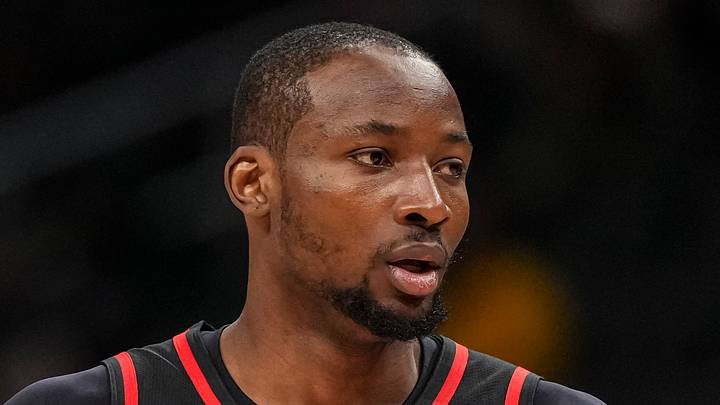
The Minnesota Timberwolves are taking a risk on Jonathan Kuminga. On a two-year, $12.4 million contract, this is a worthy gamble considering his upside and their need for a power forward. Nonetheless, it's a clear gamble, given Kuminga's flaws and rocky career.
With that in mind, let's look at some key questions that can determine if signing Kuminga proves to be a masterstroke, a swing and miss, or somewhere in between.
Can Jonathan Kuminga embrace a complementary role?
I don't care what Kuminga's agent says or what the Timberwolves allegedly told him; Kuminga's path to a lucrative contract and his ideal role with this team is as a complementary player.
Simply put, Kuminga isn't a talented enough scorer to justify a high shot creation volume, especially on a team with Anthony Edwards and LaMelo Ball. He will have to play sturdy defense, be engaged off the ball, score mainly as an interior play-finisher, set hard screens, and be okay with having very few shot-creation duties. Kuminga can absolutely thrive in this role, but it will require buy-in from him.
Offense reportedly being secondary to Kuminga's decision is certainly a promising sign. Regardless of how his career has played out so far, the proof will be in the pudding.
Frankly, this is the single biggest question around Kuminga's fit with the Timberwolves, and it's not close. If Kuminga buys into this role, he could be the Wolves' version of Aaron Gordon and prove to be the final piece of their championship hopes. The flipside is that he could hijack the offense and take away from the Wolves' more established players, which could derail Minnesota's season.
How engaged will he be as an off-ball defender?
Honestly, I feel fully confident that Kuminga can defend opposing forwards, switch onto other positions, and crash the glass. Thus far, Kuminga has proven that he can provide rock-solid on-ball defense. However, what remains to be seen is whether he can consistently be engaged and disruptive off the ball.
Playing alongside Rudy Gobert and Jaden McDaniels in a defensive-minded culture should help Kuminga maximize his upside. Still, for his size, length, and athletic gifts, Kuminga has been underwhelming as an off-ball defender. Notably, Kuminga ranked in the 29th percentile for steals per 100 possessions and the 41st percentile for blocks per 100 possessions last season.
These are subpar numbers for what Kuminga can be. To truly fulfill his upside as a high-end complementary forward, improving his defensive playmaking and overall off-ball engagement will be vital.
Will his lack of shooting alongside Rudy Gobert be a problem?
Even if Kuminga buys into a complementary role and sharpens up his defense, it will be fair to have concerns about his 3-point shooting, particularly given his fit alongside Gobert. Yes, Kuminga's finishing will primarily be his offensive role, and he's not a high-volume shooter. Kuminga is a below-average outside shooter, netting 33.2 percent of his career 3-point attempts. He's not an awful shooter, but much like Julius Randle, Kuminga is a below-average shooter that defenses won't respect.
As such, the Kuminga-Gobert frontcourt could be problematic. Unfortunately, backup center Joan Beringer won't provide any floor spacing either. Playing Kuminga alongside a non-spacer at all times could prove to be a major issue, as it would clog the driving lanes for Edwards and Ball. Now, the extra creation of Ball should ensure that things aren't as bad as last season. Furthermore, LaMelo could help Kuminga improve as a shooter, and he made it work with Miles Bridges, who is similarly a shaky shooter.
The lack of frontcourt spacing could still be a problem, though, and if Kuminga doesn't improve as a shooter, that could create some real issues for the Timberwolves.
 Add us as a preferred source on Google