

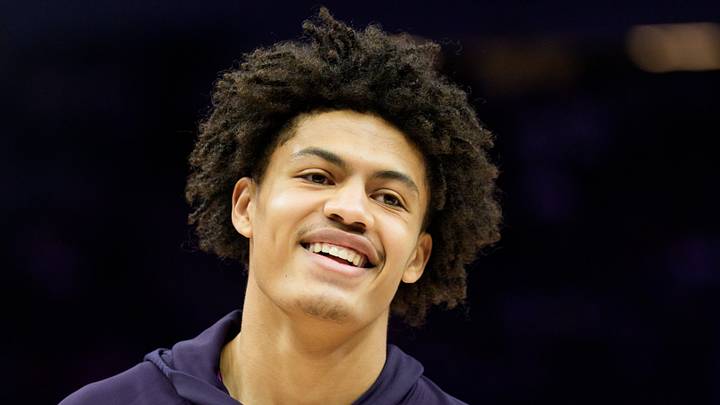
Second-year big man Joan Beringer is one of the Minnesota Timberwolves' most exciting players. After flashing his upside in limited minutes as a rookie, Beringer is now slated to be Rudy Gobert's primary backup. There's a lot of general excitement about what Beringer can do in this role. But where can he specifically help the Wolves? And beyond simply being a backup center, why is he so important to the team?
With this in mind, let's unpack some specific problems that Beringer can solve.
Joan Beringer can stabilize the non-Rudy Gobert minutes
By far the biggest nagging problem that Beringer can solve is the Wolves' non-Gobert minutes. I know that might sound like a basic one. However, anyone who has closely followed the team knows that the non-Gobert minutes have been a sizable issue.
Relevantly, the Wolves' defense was 11.8 points per 100 possessions worse when Gobert was off the floor last season, per Cleaning the Glass. The year before, they were 7.8 points per 100 possessions worse when Gobert was off the floor. These struggles came down to not having rim protection outside of Gobert, as neither Julius Randle nor Naz Reid provided this skill. Thankfully, Beringer should be able to fill this void.
He is a freaky athlete who can block shots at a high rate while also being able to switch onto the perimeter. Granted, it's a small sample size, but according to Basketball Index, Beringer ranked in the 98th percentile for rim disruption. Furthermore, in the Timberwolves' first preseason game, the Milwaukee Bucks shot just 3-for-13 inside the arc with Beringer on the court.
Now, Beringer needs to work on defending without fouling, and he's still a second-year big man. However, there's a strong chance he can put everything together and help the Timberwolves stay afloat without Gobert, which would ultimately make Minnesota a much more complete team.
Beringer can help ease concerns about the Timberwolves' rebounding
One of the biggest concerns with the Timberwolves' smaller and faster identity is that they'll struggle on the glass. This is a totally valid concern, particularly since the Wolves weren't an elite rebounding team last season. They notably ranked just 13th in rebounds per game. Beringer's athleticism and high motor can help immensely in this regard, though.
In limited minutes as a rookie, Beringer was far more effective as an offensive rebounder than a defensive rebounder. Per Cleaning the Glass, he ranked in the 96th percentile for offensive rebounding percentage and the 10th percentile for defensive rebounding percentage. Stats aside, Beringer has the physical tools and hustle to be a menace on the glass, and he can help ease some of the concerns about their rebounding.
Beringer can provide some offensive juice at the center position
Let's be honest: Gobert is a historically great rim protector and defender, but he has certain offensive limitations. Look, I'm not sure Beringer will be ready enough to truly be an offensive force in his second year. Still, his offensive ceiling is unequivocally higher than Gobert's, and it would certainly be nice for the Wolves to have a little bit more offensive juice from the center position.
Remember those on/off stats about Gobert's defense? It's almost the opposite story on offense, as last season, the Wolves were 8.4 points per 100 possessions worse with Gobert on offense. Beringer's sturdy hands and quickness could make him one of the league's best rim runners, starting this season. Plus, he's flashed some ability to attack the rim as a driver, including on this play during the Wolves' first preseason game.
Playing alongside LaMelo should unlock some of his offensive upside. If Beringer can make some strides on offense, the sky will truly be the limit for Minnesota.
 Add us as a preferred source on Google