

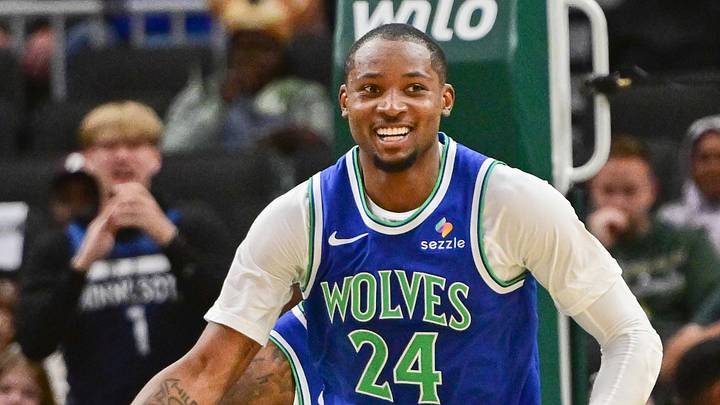
The Minnesota Timberwolves presented plenty of excitement in their preseason opener against the Milwaukee Bucks on Monday night. But lost in the positives of a 116-97 victory was their rebounding, which validated some of the concerns they had going into this season.
Sure, the Wolves had an overall 51-47 advantage on the glass, but things were tilted in Milwaukee’s favor – especially when Rudy Gobert wasn’t on the floor. According to The Athletic’s Jon Krawczynski, the Bucks grabbed nine offensive rebounds, which led to 15 of their 48 points in the first half. Milwaukee also had a 14-9 advantage in offensive rebounds for the game, and outside of Joan Beringer’s seven rebounds off the bench, no Timberwolves player had more than four rebounds outside of Anthony Edwards and LaMelo Ball, who each had four.
“We’re kind of limited in size at the four position,” Edwards admitted to Krawczynski after the game. “They had Kel’el Ware and Myles Turner out there with Jericho Sims, so just box out instead of outjumping, because we ain’t going to win that way.”
With Jonathan Kuminga grabbing just two rebounds in 14 minutes, rebounding has become a key storyline in advance of this year, and it’s something to monitor as the Wolves look to get over the hump in the Western Conference.
The Timberwolves’ trade-off at the four showed up in their preseason opener
The Wolves have tried to construct a younger, faster team than they’ve had in recent years, and a lot of that showed up on Monday night. But the trade-off has been replacing size with smaller, more athletic players, which shows up when the Wolves are trying to track down loose balls.
A lot of this comes from what Julius Randle and Naz Reid are leaving behind. While both players’ departures represented having to give up something to get something in return, they were second and third on the team in rebounds per game and combined for 11.9 boards per contest last season.
That doesn’t seem like a big number, probably because Gobert averaged 11.5 rebounds per game last season. But it was a significant blow to a team that was 19th in defensive rebound percentage a year ago. It was also something that Finch admitted was one thing he pushed to Kuminga before he signed with the team last month.
“I think the rebounding piece is important,” Finch told MinnPost’s Britt Robson during an interview that was released on Sept. 14. “I was just talking to [Kuminga] today: ‘If you rebound at a high level for us, it is going to be such a shot in the arm.”
For what it’s worth, Kuminga didn’t relay that message to the court on Monday night. But he also admitted that there’s an adjustment period with all of the new faces on the team.
“We all gotta go watch film, work on it, and practice it so we can be a good rebounding team and not just leave Rudy by himself on the boards,” Jonathan Kuminga said. “We all, collectively, have to go get it. It’s something we’ve been talking about, and we’ve got to get better at it.”
Even when the rebounding showed promise, there was an underlying problem. While Beringer tied Gobert for the team lead in rebounds, he committed three fouls in just under six minutes in the first half. With his size being the immediate replacement for Gobert when he’s off the court, Finch admitted that the 19-year-old was still “a work in progress,” which is an accurate way to describe Minnesota’s rebounding as they prepare for next season.
Jonathan Kuminga needs to be better to solve the Timberwolves’ rebounding issues
The Timberwolves’ rebounding issues won’t take long to surface in the Western Conference. The Houston Rockets (48.1) and San Antonio Spurs (47.0) were the top two teams in the NBA last season in rebounds per game. While the Oklahoma City Thunder tied with the Wolves for 12th with 44.1 rebounds per game, the Thunder still have their top two leading rebounders in Isaiah Hartenstein (9.4 RPG) and Chet Holmgren (8.9 RPG), and the Wolves will need to figure it out after what happened in Monday’s opener.
The good news is they have the foundation of a good rebounding team. While Beringer has struggled with foul trouble, he averaged 10.5 rebounds per 36 minutes during his rookie season. Kuminga also hasn’t been much of a rebounder during his career, with an average of 4.2 boards per game. But he showed progress with a career-high 5.6 rebounds per contest and 8.8 rebounds per 36 minutes last season.
Even the addition of Ball is a boost toward the Wolves' rebounding, as his four rebounds came in 17 minutes, and Edwards made it sound like sharpening their technique to complement their athleticism could be the difference in grabbing a couple of extra loose balls.
One preseason game isn’t enough to sound the alarm. But on a night when a lot of things went right, the Timberwolves will need to fix their rebounding in order to become a true contender in the Western Conference, and it could be Kuminga’s performance at the four that could determine how good they could be.
 Add us as a preferred source on Google