

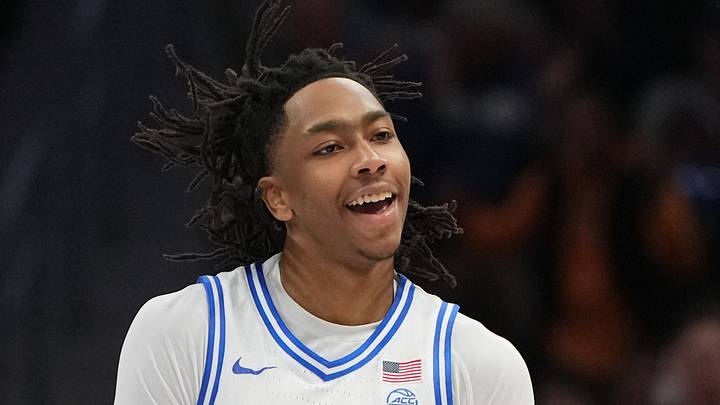
It seems unlikely that Isaiah Evans will find a way into the Minnesota Timberwolves’ rotation. For one, he wasn’t a first-round pick—as many had projected him to be—instead being selected with the third pick of the second round (33rd overall).
There’s also the fact that Chris Finch doesn’t often play rookies, who can struggle to find regular playing time. Examples of this include Joan Beringer, Rob Dillingham, Terrence Shannon Jr., and Leonard Miller.
So, it’s up to Evans to prove to Finch that he deserves to play. It won’t be easy, but here’s how he can do so.
Shoot like he did as a freshman
Coming off the bench in 2024–25, Evans’ main role was to knock down 3-pointers. He averaged 13.8 minutes per game but attempted 4.1 3-pointers per outing. Evans connected on 41.6 percent of them, and 81.4 percent of his field-goal attempts were from beyond the arc.
After entering the starting lineup last season and seeing his minutes double, Evans saw his 3-point accuracy dip to 36.1 percent. However, it improved as the year went on, and he shot just under 40 percent from long range in ACC play. The 20-year-old also showed more confidence in taking the ball to the basket.
If Evans can make nearly half of his 3-point attempts during the preseason, he will at least put himself on Finch’s radar.
Put on some weight
Yes, the Timberwolves roster a player like Jaden McDaniels. He has a slender frame but still provides defensive intensity and fearlessness when going to the hoop.
That won’t work for everyone, though. Evans measured 6-foot-5.5 and weighed 186 pounds at the draft combine, a good 10 pounds more than his listed weight at Duke. That’s a good sign that he realizes a little extra weight will help him better absorb contact and be more physical on the defensive end. Still, he'll continue to bulk up to survive on defense.
Find a secondary skill
There’s a clear path to a long NBA career for Evans, and it involves his long-range shooting. However, there is no other obvious strength for the 6-foot-6 wing.
Evans had relatively low rates of both rebounds and assists during his two college seasons. Evans' playmaking abilities weren't showcased often at college or in the summer league. His rates weren’t as low for steals and blocks, but they were also far from elite. He isn’t going to find himself on the court for his defensive chops, as Jaylen Clark has.
What else is Evans good at as an NBA player besides outside shooting? The fact that this question needs to be considered before it can be answered means that Evans needs to provide another reason or two why he should play.
A year on the bench won’t be the worst thing
I didn’t want to include this as a way for Evans to get on the floor, but the most likely way would be for the team to suffer multiple injuries at some point. Let's hope that doesn't happen. For now, it looks like the depth chart includes veterans who will have more of Finch’s trust, particularly early in the year.
Players such as Josh Green, Shannon Jr., and Clark seem to be in line to play before Evans. It may not be the worst thing, though, if his rookie year is spent mostly on the bench or in the G League. Look at Beringer. It seems as if he will go from barely playing as a rookie to being the first big off the bench in his second year.
 Add us as a preferred source on Google