

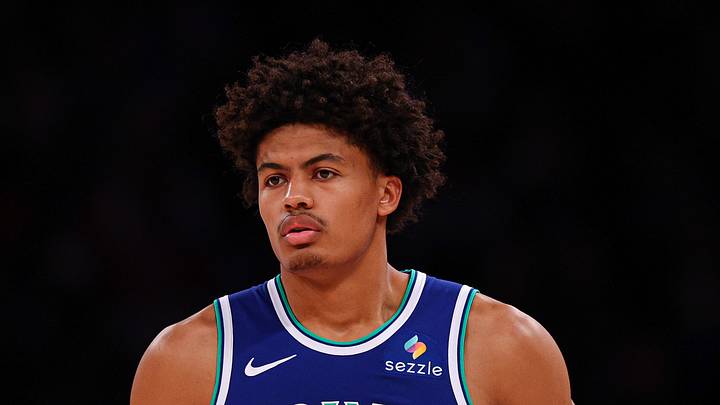
Heading into the season, one of the biggest concerns about Joan Beringer earning a bigger role with the Minnesota Timberwolves was his ability to stay out of foul trouble and play disciplined defense. This was a reasonable worry, considering that Beringer racked up 5.4 fouls per 36 minutes in limited minutes as a rookie and that he struggled with fouls in the preseason.
Thankfully, Beringer has shut down this concern; his fouls per 36 minutes are down to 3.4, and similarly, his foul percentage is down from 18.1 to 7.2. Needless to say, this area of growth is a clear positive. However, it comes with a trade-off. His blocks are down, and his impact as a rim protector has decreased. Specifically, his blocks per 75 possessions are down from 3.9 to 2.4, while his opponent rim field goal percentage vs. expected rim field goal percentage is down from the 83rd percentile to the 37th.
So while it's great that Beringer has fixed his foul problem, he needs to find a way to balance this increased discipline with rim protection. A selling point of Beringer as a prospect was his shot-blocking. We saw this upside in his rookie year, but as we've established, his impact around the rim hasn't been there.
Before further exploring Beringer's impact, I want to shout-out Wolves Clips on Twitter for the stats mentioned earlier, and advocate for the NBA to allow them to use clips, as they are a great resource for Wolves content.
Joan Beringer cutting back on fouling has hurt his impact as a rim protector
One reason why I was so excited about Beringer heading into the season was his ability to stabilize the defense when Rudy Gobert is off the floor. In theory, the Wolves should always have one high-end rim protector on the court, whether that's Beringer or Gobert. Unfortunately, this hasn't been the case due to Beringer scaling back his defensive aggression.
To be clear, Beringer has made a positive impact overall with his activity on the glass and his ability to catch lobs. Still, his defense has left some to be desired, particularly in the rim protection department.
In addition to the stats mentioned earlier, it's worth noting that the Timberwolves' defense has been 15.3 points per 100 possessions worse with Beringer on the court. Maybe this is just a small sample size, and to be fair, there's always going to be somewhat of a drop-off between Gobert and his backup.
Again, though, you'd like to see Beringer make more of an impact on defense, especially given his archetype as an athletic rim protector.
Beringer was too block-happy last season, and that led to some unnecessary fouls. Likewise, he also had some unnecessary gambles.
Regardless, it also led to him deterring more shots around the rim and some really awesome blocks. At his best, Beringer will be making a consistent impact as a rim protector. By playing more conservatively, Beringer's presence around the rim hasn't been felt. Even if it leads to a slight uptick in his fouls per game, I'd like to see Beringer be a bit more aggressive and challenge more shots around the rim.
Beringer's strength on defense is his elite athleticism. He has the potential to be a fantastic shot-blocker. At this stage of his career, Beringer's defensive impact is centered around his verticality, not physicality. Thus, playing conservatively and not challenging as many shots around the rim lessens his defensive impact. The numbers bear this out.
Beringer was too aggressive a rookie, and in an effort to fix this problem, he's gone too far in the opposite direction. Ideally, he can find a happy medium and maximize his defensive impact.
The good news is that the second-year big man has been impactful in his role off the bench, and he has plenty of time to grow. Nonetheless, discovering this happy medium between aggression and control is clearly something for him to work on.
 Add us as a preferred source on Google