

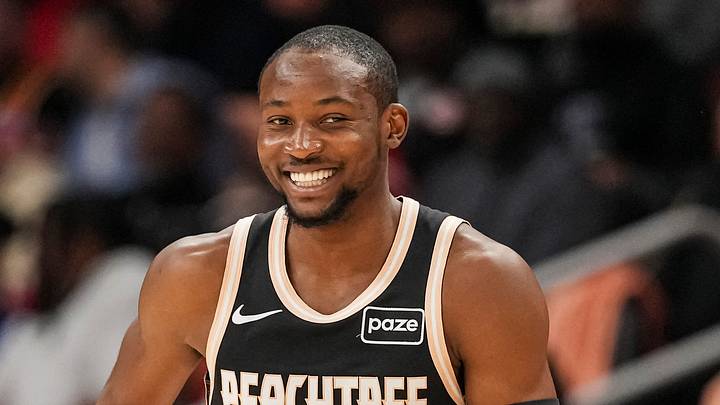
Unsurprisingly, the Minnesota Timberwolves signing Jonathan Kuminga has been a polarizing move. Yes, Kuminga fills the Timberwolves' need for power forward play and was the highest-upside solution on the open market. However, detractors point to Kuminga's inability to adjust to a complementary role. He never truly embraced this role with the Golden State Warriors, and his shot diet skews toward isolation ball, making this a fair concern.
There are some promising signs, though. Firstly, Kuminga turned down significantly more money from the Los Angeles Lakers to sign a two-year $12.4 million deal with the Wolves. Additionally, the Timberwolves' roster can maximize Kuminga on both ends of the floor. A recent article from Jon Krawczynski of The Athletic revealed what made Minnesota stand out for Kuminga. While there were a lot of positive signs in this article, these two quotes stand out to me.
“Ant was super active in the recruitment of him,” Turner told The Athletic. “One thing he did was focus his message on, we’re gonna really guard here. Everybody looked at the offensive end. JK and I looked more at the defensive end.”
“He made this decision because of the defensive versatility of this team,” Turner said. “Offense is secondary to what he’s thinking about. It’s going to be whatever we gotta do to win that night. Nobody is going to care about stats or shots.”
The ultimate proof will be in the pudding, but these quotes strongly indicate that Kuminga is ready to embrace a complementary role. This is great news for the Timberwolves, as they simply need a high-end role player, not another featured offensive player.
Jonathan Kuminga's defensive impact will be crucial
Starting with the defensive side of things, as this is the main void that Kuminga fills for the Timberwolves and it was reportedly his top priority. Kuminga gives the Timberwolves an option against physical forwards, something the team lacked since gutting their forward room to trade for LaMelo Ball. He also helps with the rebounding concerns that come with a smaller frontcourt. Impressively, Kuminga ranked in the 94th percentile for defensive rebounding percentage per Databallr.
Given his sturdy 6-foot-7, 225-pound frame and general athleticism, he is well-suited to guard physical forwards. Last season was arguably the best defensive season of his career; he ranked in the 85th percentile for matchup difficulty and the 87th percentile for defensive estimated plus-minus. Furthermore, the Hawks' defense was 8.7 points per 100 possessions better with Kuminga on the court.
As such, Kuminga's defensive impact isn't hypothetical.
Still, Kuminga has room to grow as an off-ball defender. Thankfully, playing in a defensive culture spearheaded by Rudy Gobert and Jaden McDaniels will help him reach his potential. More importantly, Kuminga is clearly putting defense at a premium, so it's fair to expect him to continue improving defensively.
Should Kuminga improve as an off-ball defender, the Timberwolves will have a borderline elite defender on their hands. With their established defensive talent, that could make them a scary sight for opposing teams.
Kuminga has to walk the walk, but his agent saying that he doesn't care about stats or shots, and his focus on defense is notable given the narrative that he's a selfish player who only cares about stats.
Kuminga's offensive role with the Timberwolves
With established high-end creators in Anthony Edwards and Ball, along with Jaden McDaniels and Ayo Dosunmu having ample duties as creators, Kuminga needs to buy into the idea of less is more. Ball's playmaking can unlock Kuminga's play-finishing skill set. In turn, Kuminga will still have a meaningful role in the offense; it will just largely be predicated on others (mostly Ball) creating for him.
Having an athletic play-finisher who can also play physical defense is a massive benefit. Championship teams need complementary players like this; look at what Aaron Gordon did for the Denver Nuggets. Even if we haven't seen Kuminga adjust to this role just yet, he has the potential to thrive in it.
The flip side is that if Kuminga can't adjust to this role, he could take away from Minnesota's established talent, which would likely cause him to play fewer minutes. Fortunately, as we've established, he seems on board with playing a complementary role.
Overall, while Kuminga needs to prove himself, the early signs are that he's set to embrace this complementary role, and that's fantastic news for the Timberwolves.
 Add us as a preferred source on Google