

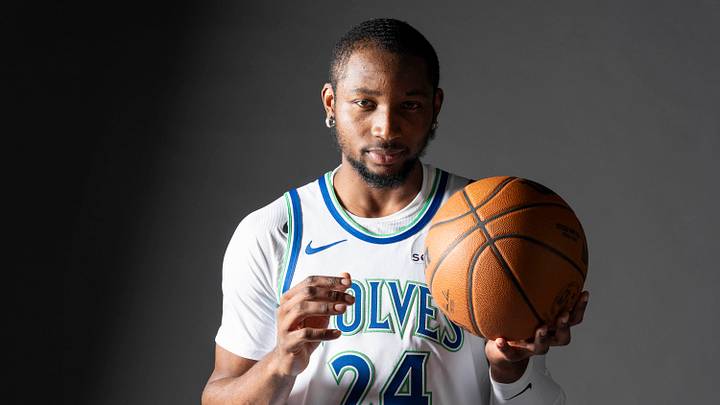
Much of the discourse around Jonathan Kuminga's fit with the Minnesota Timberwolves has been about whether he can buy into a complementary role. I've certainly wondered about this. However, what can't be lost is that Kuminga has an elite complementary skill set.
Interestingly, during media day, when discussing what Kuminga brings to the table, Chris Finch praised him for a bunch of complementary skills: rebounding, cutting, and running in transition.
"When the game boils down to somebody who needs to use their athleticism, skill, and power, and they can go somewhere that they want to go. He can do that. For us, we saw it as an ideal fit. He does some things naturally at a high level that we've not been particularly good at, like rebounding, running, transition, and finishing.... Cutting, one of the elite cutters in the game. Also, Lamelo is really good at finding movement," Finch said.
Let's put the buy-in debate aside and look into why these complementary skills could be valuable for the Wolves.
Kuminga has some complementary skills that the Timberwolves need
Kuminga is coming off the best rebounding season of his career. In 23.1 minutes per game, Kuminga averaged 5.6 rebounds. That might not sound impressive, but per Databallr, Kuminga ranked in the 94th percentile for defensive rebounding percentage. That's an elite number.
And despite having a ton of frontcourt size, Minnesota has never been a great rebounding team. Relevantly, the Wolves ranked 13th in rebounds per game last season. Former Timberwolves starter Julius Randle averaged more rebounds per game (6.7), but he ranked in the 34th percentile for defensive rebounding percentage. From this standpoint, Kuminga is an upgrade over Randle.
Plus, while Randle was a subpar positional rebounder, it was vital to find an athletic four who can crash the glass after they traded him and Naz Reid.
If Kuminga can rebound at a high rate, the Wolves will have an advantage in the possession battle, and it will lead to more transition opportunities. Rebounding will certainly be one of the most significant aspects of Kuminga's impact.
Despite the narrative about Kuminga being overly ball-dominant and taking poor shots (which has some truth to it), the reality is that he's a high-level cutter. Per NBA.com, Kuminga ranked in the 74th percentile as a cutter.
He is a superb athlete who can take advantage of defenses if they are out of position. This can help Kuminga get buckets within the flow of the offense, and it'll make him an ideal fit alongside LaMelo Ball, who is a gifted playmaker.
I've long discussed the importance of Kuminga becoming an athletic play-finisher, and cutting off the ball is a key part of the equation. As Finch noted, cutting has been an element that the Wolves' offense has lacked. Last season, they ranked 29th for points per possession off cuts and 27th for points per game off cuts, per NBA.com.
Even as I project him to be more of a play-finisher, his strength and athletic gifts will help him punish mismatches when appropriate.
Transition is one of the more intriguing parts of Kuminga's game. Given his athleticism and fast-paced style, Kuminga should be a force in transition. However, he's only ranked above the 50th percentile for transition effectiveness twice in his five-year career. Last season, he ranked in the 39th percentile. The numbers don't bear out the idea that Kuminga is an impactful transition player.
Still, you can see flashes of brilliance from Kuminga in transition, and he has all the tools to be a stellar transition player. Playing alongside LaMelo should also help Kuminga improve in transition.
If Kuminga can crash the glass, run in transition, cut off the ball, and play physical defense, he'll have no problem fitting in with Minnesota. We'll have to see him put everything together, but there's no denying that Kuminga has certain skills that could make him a fantastic complementary forward—which is exactly what the Timberwolves need him to be.
 Add us as a preferred source on Google