

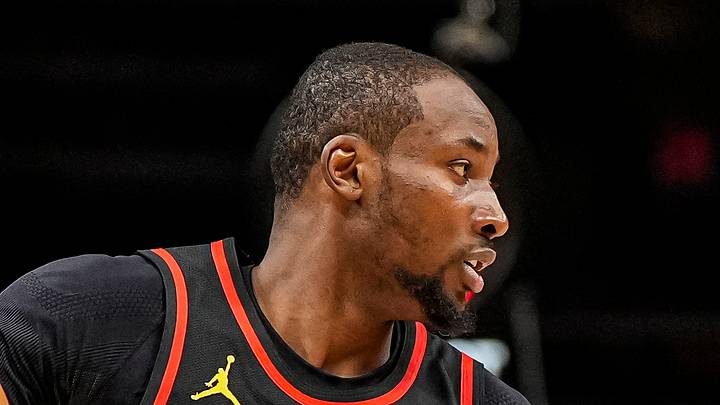
Jonathan Kuminga is on a prove-it deal with the Minnesota Timberwolves. In August, he signed a two-year, $12.4 million deal (with a player option after this season). The hope is that Kuminga will buy into a complementary role and improve some of his major weaknesses.
On a similar note, signing Kuminga to a deal like this means the Timberwolves aren't obligated to play him a major role if he struggles to fit in with the rest of the group. Chris Finch has openly said that the starting power forward role is "Kuminga's to lose."
However, if he proves to be a shaky fit with the starting lineup, whether it be because of his lack of 3-point shooting, poor shot selection, or another reason, Finch will have no problem moving him to the bench. With the contract he's on, Kuminga will have to accept this role with grace. Likewise, he'll have to accept playing fourth fiddle most nights with Anthony Edwards, LaMelo Ball, and Jaden McDaniels all getting more touches.
Kuminga also won't have to close games even if he's starting. In fact, I expect Ayo Dosunmu to be the team's primary closer.
If things don't go well, the Wolves will have a PF void, but the risk of signing Kuminga is minimal from a financial standpoint. In other words: Who cares if the guy making $6 million isn't playing a major role?
The bright side is that he proves to be an ideal fit, this contract will look like an absolute steal.
Kuminga playing a complementary role will cover up his weaknesses
Look, Kuminga is an ultra-talented player, but he's flawed at the end of the day. Hopefully, the Wolves' offense proves to be a better fit for his game, and he works through his issues as a decision-maker and 3-point shooter.
If everything goes right, Kuminga can be a supercharged role player, thriving as an athletic play-finisher around the rim on offense while being an impactful and versatile defender. Why can't he be the Timberwolves' version of Aaron Gordon? Plus, using him more in this play-finisher role can maximize some of his strengths and cover up some of his weaknesses.
Generally speaking, I feel confident about Kuminga in this role, especially considering his contract, Ball's playmaking, and the fact that he took less money to sign with Minnesota.
And what's the alternative if Kuminga doesn't want to embrace this complementary role? It's likely another long summer waiting for a contract. It's likely that this will result in him seeing a reduced role and not earning a bigger contract next summer.
Unlike Randle, the Timberwolves won't be forced to close with Kuminga during his off-nights
Now, throughout his career, Kuminga has largely been an inconsistent player, and there's some clear volatility in his game. Even in a scaled-down role, this could be the case.
In some ways, Kuminga is similar to Julius Randle. Both players are forwards with physical gifts who have an affinity for taking difficult shots. Likewise, they both make poor decisions and go through cold stretches.
The key difference is that Kuminga is the fourth option, while Randle was the second option. Minnesota asked Randle to scale up. It didn't work. A player with these flaws can't be a No. 2 option, but in a scaled-down role with a ton of surrounding talent, that's an entirely different story.
There were numerous games where Finch should have closed without Randle. Should Finch have closed more games with Reid? Sure, but the optics of doing so would be bad. Randle was the second option; the Wolves traded Karl-Anthony Towns for him, and he was making $30.8 million. All in all, closing games with Randle would have been a bad look, and it could've hurt his confidence.
Kuminga understands that he's not a focal point, and if he doesn't close games or sees his minutes fluctuate a bit, that's fine. Remember, this is a guy who often saw DNPs with the Golden State Warriors despite his immense talent. As such, not closing games or moving to a bench role wouldn't be a big deal.
Even though there will naturally be some games where the Wolves can't close with Kuminga or play him 30-plus minutes, there will be many nights where they can, and he looks awesome. This, paired with Ayo being a high-end sixth man, means Kuminga's possible volatility shouldn't be too concerning.
So while Kuminga is a flawed player, using him in a complementary role and having him on a cheap contract minimizes some of the risk. From this standpoint, it's a low-risk, high-reward move.
 Add us as a preferred source on Google