

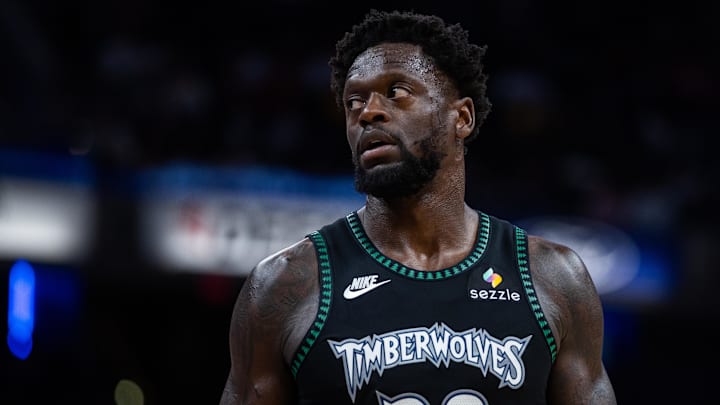
The vast majority of Minnesota Timberwolves fans are upset with Julius Randle right now. Frankly, Randle's offensive production has been underwhelming throughout the playoffs, and these problems have only been exacerbated against the San Antonio Spurs. Through three games against the Spurs, Randle is averaging just 15 points on 35.7/18.2/76.5 shooting splits.
Wolves fans' frustration has reached new heights after Randle scored just 12 points on 3-for-12 shooting in a Game 3 loss. In a game where Anthony Edwards had 32 points, Randle's lack of secondary production was a key reason why the Wolves fell short.
Without a doubt, the Spurs have exposed a familiar flaw with Randle's game -- his inability to score consistently against teams with size and rim protection. This was a concern I had about Randle heading into the series, and after a solid Game 1, the past two games have gone as poorly as possible.
The Spurs are proving to be a nightmare matchup for Randle
The Spurs have very few small defenders for Randle to attack, and if he draws someone like De'Aaron Fox, the Spurs will quickly bring a double team. And if Victor Wembanyama is around the rim, Randle's scoring is highly limited.
In addition to his scoring issues, Randle is averaging 4 turnovers and just 1.3 assists in this series. To be fair, Randle is averaging 4.7 potential assists, but there's no denying his decision-making must improve.
Diving a bit deeper beyond the initial counting stats, it's worth noting that Randle is shooting a paltry 8-for-30 against his three most common matchups (Wembanyama, Stephon Castle, and Keldon Johnson) this series. Randle is shooting an abysmal 2-for-11 against Wemby. Struggling against an all-time great rim protector is to be expected, but not to this extent.
Castle and Johnson aren't the typical players you imagine as "Randle-stoppers," but they have enough strength and skill to make him uncomfortable. Simply put, Randle's bully-ball style of play doesn't work against the Spurs.
It's still early, and Randle has a chance to right the ship. However, this series is starting to feel a lot like the ill-fated conference finals series against the Oklahoma City Thunder last year. Randle struggled a ton in this series, and there's no denying the similarities between these two defenses.
With these two teams being the standard in the West for the next decade-plus, it's worth considering Randle's future with the team (more on that later).
One of the key problems with Randle is that he doesn't have true versatility as a scorer. Randle is a fantastic mismatch punisher and isolation scorer. He is one of the strongest players in the entire league, and when teams don't have ample size or rim protection, he can look like a dominant player.
As noted, though, Randle struggles against teams with size, athleticism, and rim protection. This is partly because Randle struggles to shoot from beyond the arc, netting just 31.5 percent of his 3s in the regular season and 25.8 percent of his 3s in the playoffs. He does have a solid mid-range jumper at times, but again, it's only effective against smaller defenders.
Randle's inability to make quick reads also hurts him, especially against defenses like the Spurs.
The Timberwolves will likely make changes this offseason
These undeniable problems in Randle's game hurt the Wolves' ability to upset the Spurs. The bigger picture is that we are starting to get more evidence that Randle isn't an ideal second option next to Ant.
To win at the highest level, Edwards needs a second option who can provide consistent and versatile scoring production, especially against elite defenses like San Antonio and OKC. If this current trajectory continues, the Wolves will have to face some honest conversations this offseason.
Can Jaden McDaniels or Ayo Dosunmu scale up to this role, or will the Wolves need to trade for a true second option? Is it possible to find a true second option in a trade for Randle? If Randle stays, should his responsibilities be scaled back?
All of these are questions Tim Connelly will have to answer, barring a sudden change.
 Add us as a preferred source on Google