

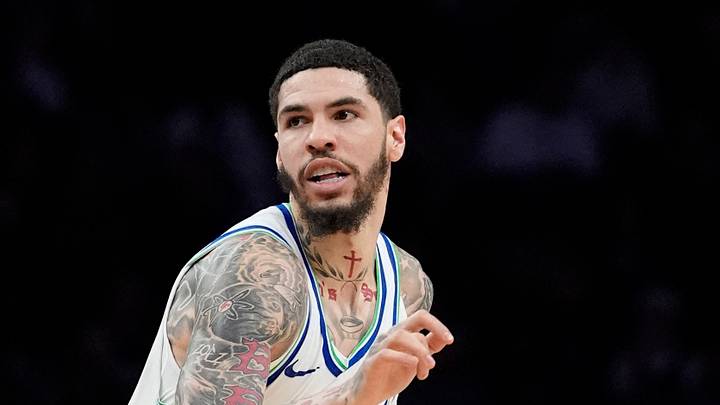
There's a ton of excitement around LaMelo Ball's fit with the Minnesota Timberwolves. Understandably so, Anthony Edwards finally has a skilled co-star and playmaker. However, Ball isn't a perfect player—one area he struggles with is dealing with physicality. And even in the preseason, teams are starting to expose this flaw.
In back-to-back games, LaMelo has faced tenacious point-of-attack defenders. Earlier this week, it was Mikal Bridges against the New York Knicks, and on Wednesday it was Ausar Thompson against the Detroit Pistons. In these two games combined, Ball has shot 4-for-12 from the field. He has found a way to make an impact as a playmaker, dishing out 13 assists, but he also posted eight turnovers. Ball particularly struggled against Thompson, as he went 1-for-5.
Thompson picked up LaMelo at full court, which at times caused the Wolves to have someone else bring up the ball. When LaMelo did bring up the rock, he struggled to get to his spots and couldn't generate consistent rim pressure. Cade Cunningham also guarded Ball at times, and his physicality also bothered Ball.
Look, it's just preseason, and everyone can have bad games against great defenders. However, this could be a common and effective strategy against Ball.
LaMelo Ball's ability to deal with physicality is a clear question mark
LaMelo is a fantastic perimeter scorer and playmaker with a height advantage at 6-foot-7, but there's no denying he's slight of frame at 180 pounds. If you want to limit Ball's effectiveness as a perimeter scorer and playmaker, then constantly getting up in his grill makes a lot of sense.
And if you have an elite on-ball defender, that could prove to be a profitable strategy. This is doubly true if you have strong rim protection. Ball's struggles around the rim are another reason why this type of defense makes sense. Notably, he has never shot above 60 percent at the rim. A big part of this is his slight frame, so even if he can beat this ball pressure, converting at the rim is a genuine question.
That's not to say Ball will have no counter against this. He can still make an impact with his playmaking, but taking away his drive-and-kick game limits the ways he can playmake. Likewise, while Ball can drain difficult 3-pointers, being forced to rely on them isn't ideal.
The good news is that not every team has the personnel to play this style of defense. Sure, they can try, but if Quentin Grimes is the one defending Ball, then it's not going to work nearly as well. Furthermore, if teams commit to this strategy with their best on-ball stopper, it's going to give Edwards a more favorable matchup to attack.
Unfortunately, the San Antonio Spurs and Oklahoma City Thunder have the perfect personnel to play this strategy. Stephon Castle is an elite on-ball stopper, but Dylan Harper and Devin Vassell are also two high-level perimeter defenders. Likewise, with Cason Wallace, Alex Caruso, and Jalen Williams, the Thunder have a bevy of perimeter defenders.
Of course, these two teams are Minnesota's primary competition. As such, LaMelo's ability to deal with physical defense is a real concern, particularly in high-leverage moments, and the preseason is already showing us that teams will lean into this strategy.
 Add us as a preferred source on Google