

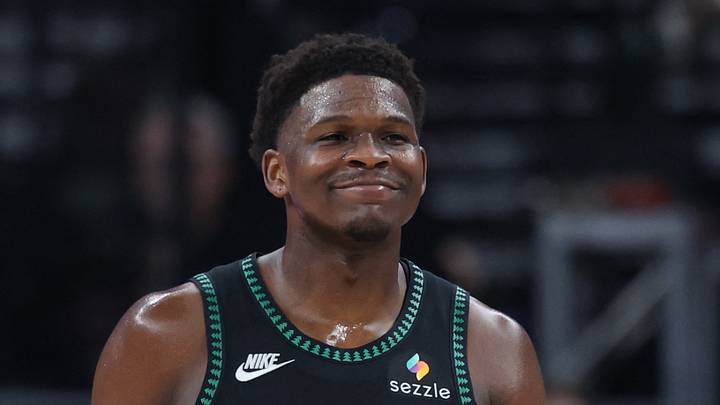
The Minnesota Timberwolves are getting closer to the 2026-27 season, and the first thing fans will notice is a new look. We’re not talking about the Wolves' new uniforms or even the pace at which Minnesota has played over the first two games. Instead, it could be a long-distance barrage that could make them even harder for opponents to deal with.
The idea was brought up by Timberwolves podcaster Dane Moore, who noticed an increase of ’ 3-pointers in the first two preseason games. Moore believes that more attempts and increased accuracy from beyond the arc could be a major change to the Timberwolves' offense, and it could use the same blueprint that the 2023-24 Boston Celtics used to win the NBA championship.
“I think this Wolves team can just be one of the best 3-point shooting teams this year…and how I would define that is volume and accuracy,” Moore said on the Dane Moore NBA Podcast. “...I don’t think this is a high bar. I don’t think this would be a ridiculous thing for the Wolves to at least be [in the] top five in 3-point volume and top five in 3-point accuracy. That Boston team two years ago, that was their super power. …I’m just saying this is a required part of the path to being the best offense in the NBA.”
Timberwolves’ 3-point shooting could be the blueprint for a championship offense
Looking at Moore’s main comparison, he has a point. The Celtics ranked first in 3-point attempts (42.5) and second in 3-point accuracy (38.8 percent) during that season, and it helped them finish second in the NBA with 120.6 points per game. Boston also dominated the Eastern Conference with a 64-18 record and was able to go all the way by winning a title.
To do that, it was a team effort. Jayson Tatum (8.2), Derrick White (6.8), Sam Hauser (5.9), Jaylen Brown (5.9), and Kristaps Porzingis (5.1) all had over five 3-point attempts per game for the Celtics, and eight players had at least four, with Jrue Holiday (4.7), Payton Pritchard (4.7), and Al Horford (4.0) getting involved.
In addition, seven of those players shot the NBA average of 36 percent on 3-pointers, while Holiday, Hauser, and Horford all shot over 40 percent. Even Brown, who is a career 35.8 percent 3-point shooter, was able to come close to his average, knocking down 35.4 percent to create an effective weapon from downtown.
The Celtics aren’t the only instance where finishing in the top five in 3-point volume and accuracy can jump-start an offense. Over the past 10 years, there have been nine teams to finish in the top five in both categories. Only two teams – the 2025-26 Charlotte Hornets and the 2024-25 Timberwolves – finished outside of the top four in points per game, and each team, except for last year’s Hornets, at least advanced to their conference semifinals.
In addition, the Cleveland Cavaliers and Golden State Warriors both accomplished the feat during the 2016-17 season and met in the NBA Finals with the Warriors defeating Cleveland in five games.
Year | Team | 3-Point Attempts | 3-Point Percentage | Points Per Game | Season Result |
|---|---|---|---|---|---|
2025-26 | Hornets | 43.3 (2nd) | 37.8% (3rd) | 116.0 (13th) | Lost in Play-In Tournament |
2024-25 | Cavaliers | 41.5 (4th) | 38.3% (2nd) | 121.9 (1st) | Lost in Conference Semis |
2024-25 | Timberwolves | 39.9 (5th) | 37.7% (4th) | 114.3 (13th) | Lost in Conference Finals |
2023-24 | Celtics | 42.5 (1st) | 38.8% (2nd) | 120.6 (2nd) | Won NBA Finals |
2022-23 | Warriors | 43.2 (1st) | 38.5 (2nd) | 118.9 (2nd) | Lost Conference Semis |
2021-22 | Bucks | 38.4 (5th) | 36.6% (5th) | 115.5 (3rd) | Lost Conference Semis |
2020-21 | Jazz | 43.0 (1st) | 38.9% (5th) | 116.4 (4th) | Lost Conference Semis |
2016-17 | Cavaliers | 33.9 (2nd) | 38.4% (2nd) | 110.3 (4th) | Lost NBA Finals |
2016-17 | Warriors | 31.2 (5th) | 38.3% (3rd) | 115.9 (1st) | Won NBA Finals |
Timberwolves have everything they need to a force from downtown
Looking at the Timberwolves going into this season, you can see the foundation of a similar approach. The Wolves finished 17th in 3-point attempts but were sixth in 3-point percentage at 37.0 percent. They also have several of their top shooters returning, including Anthony Edwards (8.4 attempts, 39.9 percent shooting), Bones Hyland (4.2 attempts, 38.8 percent), Ayo Dosunmu (3.6 attempts, 41.4 percent), and Jaden McDaniels (3.4 attempts, 41.2 percent).
Donte DiVincenzo should also make their long-range attack more important, as he attempted 7.9 3-pointers per game and shot 37.9 percent from downtown during the regular season. While he won’t start the season as he rehabs from a torn Achilles tendon, he’s expected to return at some point and give the Wolves a bigger weapon in their back pocket.
But their biggest ace may be adding Ball to the mix. Ball was the front man for last year’s Hornets team that used 3-pointers to their advantage. While that didn’t help them get to the top of the league in scoring or make a deep playoff run, he also set his teammates up in situations to knock down those shots, and now he has a better supporting cast that could take advantage.
In addition, Ball can also launch it from downtown. In his six seasons in Charlotte, Ball averaged 8.8 attempts per game, knocking down 36.5 percent of them. But even if he is an average 3-point shooter, that threat could make defenses leery and help create chances for his teammates.
The preseason opener against the Milwaukee Bucks didn’t see this come to fruition as Minnesota shot just 25.7 percent from beyond the arc. But it didn’t come from a lack of effort, as they jacked up 35 3-pointers. The volume stuck around for Thursday’s loss to the Indiana Pacers, but the Wolves shot much better, converting at a 46.3 percent clip.
It’s something that could make the Wolves offense more potent going into this season and could help Minnesota put the pressure on opponents and get back to being a power in the Western Conference.
 Add us as a preferred source on Google