

The Minnesota Timberwolves had a lot of things stand out in their first preseason game against the Milwaukee Bucks. But aside from their new uniforms and their struggles on the glass, the biggest thing fans may have noticed is that they’re playing at a much faster pace than they were a year ago.
The Wolves played a traditional estimated pace of 105.1 possessions per 48 minutes on Monday night, and it could be seen from the opening tip-off. Likewise, starters played around 17 minutes and averaged 103.2 possessions, according to the Minnesota Star Tribune’s Sarah Todd, Michael Rand and Chris Miller.
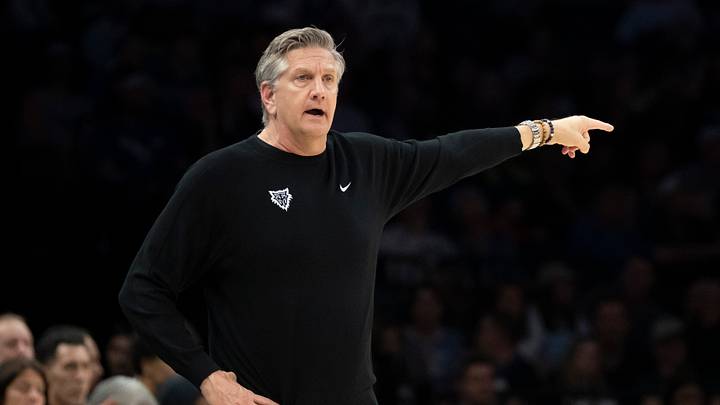
For a team whose pace was a major issue over the past two seasons, seeing the Wolves racing up and down the court in the 116-97 was a positive development. It could also show that Chris Finch’s desire to play faster wasn’t just lip service and could be a key weapon to help them take another step forward this season.
“I want to continue to play faster, offensively, for sure,” Finch told MinnPost’s Brit Robison last month. “We have got to get passing back into our game. We didn’t pass enough last year; at times I thought we even became reluctant passers. I still want our players to play with great freedom, but within a structure, and that structure might change a little bit and we’ll see how that looks.”
The Timberwolves spent their offseason trying to play faster
When it comes to the past two seasons, playing at a high tempo wasn’t something the Wolves were known for. Playing two big men, Julius Randle and Rudy Gobert, on the court at the same time, Minnesota ranked 25th in pace.
Now, Minnesota played a little faster, ranking 10th in pace. But it still wasn’t enough. Seeing Randle become a black hole to play “Bully Ball” in the paint and having Edwards try to do everything by himself in iso concepts became staples of the offense, and it was enough for Finch and president of basketball operations Tim Connelly to build a faster roster this summer.
A lot of the talk about adding LaMelo Ball was to take pressure off Anthony Edwards, but he also serves as a facilitator that the Wolves haven’t had since Mike Conley wasn’t fighting off Father Time. Trading away Randle and Naz Reid also shifted toward a more athletic approach, and the Wolves will rely on Jonathan Kuminga as a starter at power forward and have Joan Beringer as an athletic big man off the bench who can push the pace at the center position.
This complements some of the existing components on the roster, such as the “Twin Turbos” duo of Ayo Dosunmu and Bones Hyland, and it all came together against the Bucks.
The Timberwolves showed why their new-look offense could be special
It may have only been a preseason game, but the structure looked tremendous on Monday night. The Timberwolves used plenty of pick-and-roll opportunities to create opportunities and with Ball as the frontman, he dished from the top of the key to Kuminga, who went to the rim for the first bucket of the preseason 10 seconds into the game.
A few minutes later, Jaden McDaniels came down with a rebound off a Tyler Herro miss and immediately pushed the pace. After finding Edwards with a pass as he approached mid-court, Edwards tossed the ball to the paint for a wide-open alley-oop to Rudy Gobert before the defense could get set.
Putting pressure on the Bucks’ defense with their pace was a constant theme of the night as Hyland turned a steal into an alley-oop to Kuminga with 6:26 left in the second quarter. What’s even scarier is that the Wolves could have played even faster if it weren’t for their defense, which forced longer possessions and held Milwaukee to 29 percent from the floor in the first half.
While the Wolves played faster, there seemed to be a flow to the offense on Monday that they didn’t have over the past couple of years. It could validate their approach to the offseason and could lead to a dynamic team that could make some noise in the Western Conference this season.
 Add us as a preferred source on Google