

While a subsequent roster move to duck the second apron is on the way, the Minnesota Timberwolves made their last big offseason addition by signing Jonathan Kuminga to a two-year, $12.4 million deal. By trading for LaMelo Ball earlier this summer, the Timberwolves addressed their glaring need for playmaking and creation alongside Anthony Edwards.
Landing Ball cost the Timberwolves Julius Randle and Naz Reid, creating a glaring need at the power forward position. Say what you will about Kuminga, but he was undoubtedly the highest-end forward option on the market.
With this in mind, let's look at the Timberwolves' full depth chart and break down the strengths and weaknesses of this group.
Minnesota Timberwolves full depth chart
Point guard: LaMelo Ball
Shooting guard: Anthony Edwards
Small forward: Jaden McDaniels
Power forward: Jonathan Kuminga
Center: Rudy Gobert
Guards: Ayo Dosunmu, Bones Hyland, Zyon Pullin (two-way)
Wings: Jaylen Clark, Isaiah Evans, Terrence Shannon Jr., Josh Green
Donte DiVincenzo (injured)
Forwards: Trey Lyles, Enrique Freeman (possible two-way), Trey Kaufman-Renn (possible two-way)
Centers: Joan Beringer, Rocco Zikarsky (possible two-way)
Timberwolves' projected starting lineup
Point guard: LaMelo Ball
Shooting guard: Anthony Edwards
Small forward: Jaden McDaniels
Power forward: Jonathan Kuminga
Center: Rudy Gobert
Kuminga slides in nicely with the starting lineup, giving the Timberwolves a physical and athletic forward. Had they not signed him, the Wolves would have gone into the season with a power forward- by-committee rotation, especially because they want to keep McDaniels at the point of attack. As such, they would have been at a disadvantage guarding physical forwards and rebounding.
He's not a perfect player, but Kuminga has proven to be a high-level on-ball stopper against forwards, and an active rebounder. Hopefully, playing alongside McDaniels and Gobert can maximize him as an off-ball defender as well.
On the other side of the ball, Kuminga should be a perfect fit for the Timberwolves' fast-paced identity. If Kuminga buys into a play-finishing role, LaMelo can unlock his upside and feed him open shots around the basket. Having an athletic forward who can punish mismatches and thrive around the rim should boost the Timberwolves' offense.
The dynamic backcourt of Ball and Edwards alone will make the Timberwolves' offense elite. Regardless, Kuminga should be the final piece of the puzzle, giving them an element they lacked in the past.
There are some risks, including the spacing with a Kuminga and Gobert frontcourt, along with Kuminga's ball-stopping tendencies. It's also worth wondering how this will impact McDaniels, who felt poised for a breakout season. For the price and considering their glaring need, though, Kuminga is absolutely worth the risk.
Without a doubt, this is one of the most talented and well-rounded starting lineups in the league.
Timberwolves' projected bench unit
Note: we are forgoing traditional positions with the bench unit, since there will need to be some level of positional flexibility.
Guards: Ayo Dosunmu, Bones Hyland, Zyon Pullin (possible two-way)
Wings: Jaylen Clark, Terrence Shannon Jr., Isaiah Evans, Josh Green
Donte DiVincenzo (injured)
Forwards: Trey Lyles, Enrique Freeman (possible two-way), Trey Kaufman-Renn (possible two-way)
Centers: Joan Beringer, Rocco Zikarsky (possible two-way)
With Kuminga in the fold, Dosunmu will slide into a super-sub role. This was already a possibility if the Timberwolves wanted a low-usage starter. Regardless, Dosunmu can be one of the best bench scorers in the league and fill this key void of bench creation. I'd still expect Dosunmu to close plenty of games if he has the hot hand, though. Dosunmu's ability to scale up or thrive as a pure complementary guard is what makes him so valuable.
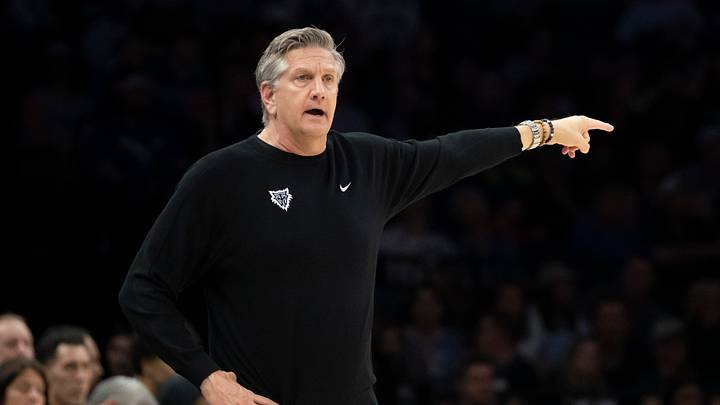
Hyland and Shannon also offer some bench creation. Beringer, while young, should be able to handle a bigger role and help the Timberwolves stay afloat without Gobert. I'd project Dosunmu, Shannon, Hyland, and Clark as the nine mainstays of Chris Finch's rotation.
Other noteworthy things include how this highlights why Minnesota's need for a PF was so pressing. Lyles, who was out of the league last year, is the Wolves' only bench forward on a standard contract. Even after signing Kuminga, this lack of frontcourt depth should be somewhat of a concern.
To this end, it wouldn't surprise me if we see Clark or Shannon guard opposing power forwards when Kuminga is on the bench, despite them being traditional wings. Patching this together for 48 minutes wouldn't be ideal. Still, in a pinch, for limited minutes, I don't think this should be a major concern.
Green is listed on the depth chart for now. However, he is the most likely candidate to be waived or traded, as the Timberwolves must drop below the second apron.
None of these players will likely earn minutes, but the Timberwolves' two-way battle is worth noting. Recent second-round pick Kaufman-Renn remains unsigned, with Pullin, Freeman, and Zikarsky occupying all three spots. Unless one of these players earns a standard contract, the Wolves will have to part ways with one of them.
Another clear theme that carries over from the starting lineup to the bench is pace. Ayo, Hyland, Shannon, and Beringer in particular all thrive playing fast. Even if you have concerns about this team, their fast-paced style and plethora of creation threats will make the Timberwolves a tricky matchup.
 Add us as a preferred source on Google